
6 Best Flooring for Garage Gym Floors Over Concrete in 2026
As an Amazon Associate, this website earns from qualifying purchases.
The short answer
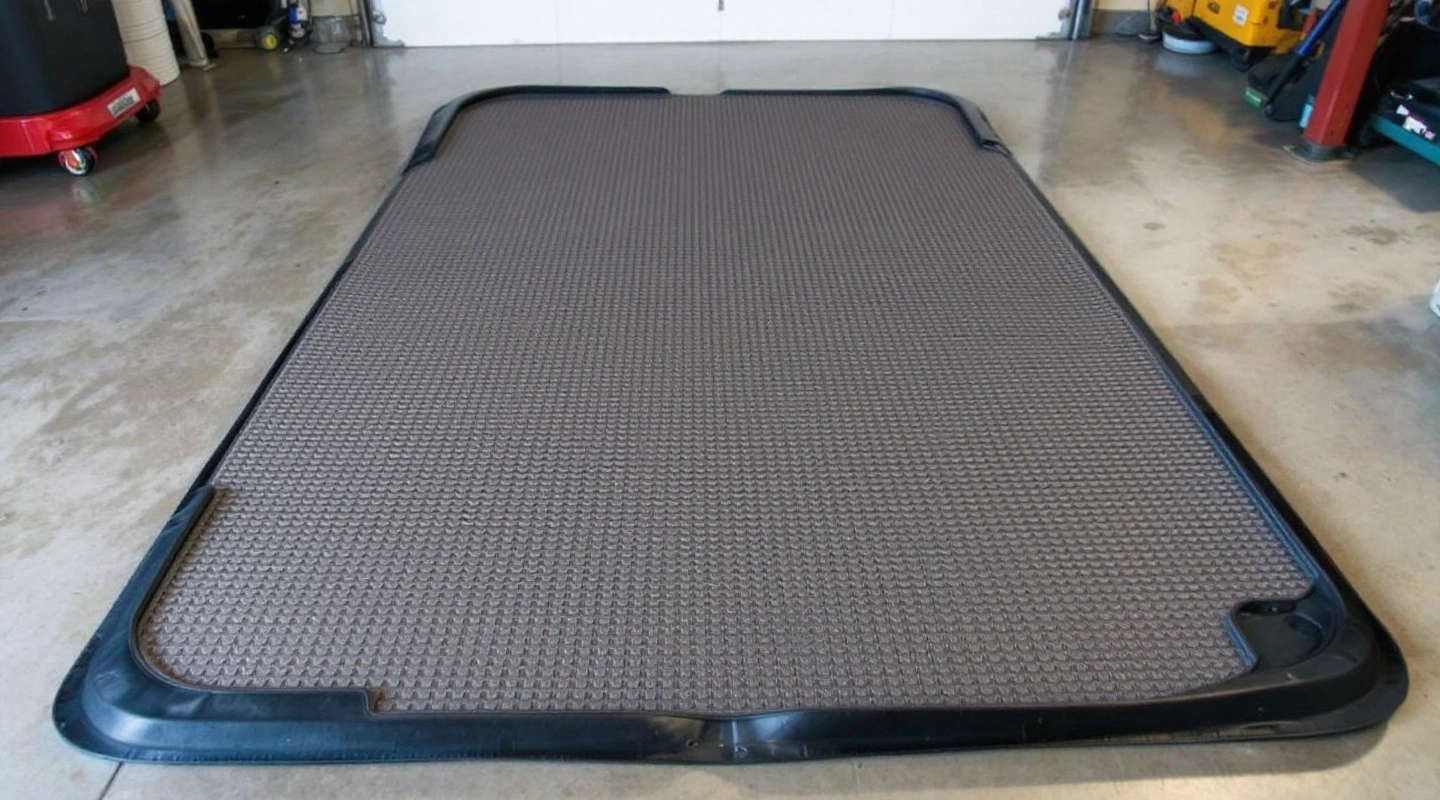
For most garage gyms with a rack and dropped plates, the DWC 4 x 6 ft rubber mat is the best floor. Choose American Floor Mats stall tiles if you want the same rubber in 2 x 2 pieces, and check any product's fit for cold, bare concrete before you buy.
Last updated September 2026
Contents22
- #1. DWC 4 x 6 ft Rubber Mat: best overall for a garage gym
- #2. American Floor Mats Stall Tiles: best stall rubber in small pieces
- #3. American Floor Mats 4 x 6 ft Stall Mat: best US-made stall mat
- #4. ProsourceFit 1-inch Puzzle Mat: best foam tile for a rack corner
- #5. Rubber-Cal Eco-Sport Tiles: best for a damp garage
- #6. Rubber-Cal Elephant Bark Roll: best for a light-use zone
- Factors to consider when choosing flooring for garage gym use
- How much rubber a rack zone needs
- A simple lifting platform
- How we picked flooring for garage gym use
- Zoning a shared garage
- Renting or planning to move
- How a garage differs from an indoor room
- Matching flooring to what happens in the garage
- A simple way to work through the choice
- Common mistakes in garage installs
- Setup notes for concrete
- New rubber smell
- Cleaning a garage gym floor
- Warranty in a high-traffic garage
- Cords, fans and wall fixtures
- Our verdict on flooring for garage gym setups
Our top 6 picks
- 1Best overall for a garage gym
 DWC 4 x 6 ft Rubber Mat, 3/4 in
- 3/4-inch recycled tire rubber, 4 x 6 ft
- About 115 lb per mat
- Cuts with a razor or box cutter; made in Canada
- 2Best stall rubber in small pieces
 American Floor Mats Heavy Duty Stall Tiles, 3/4 in (Set of 9)
- Nine 2 x 2 ft rubber tiles, 0.75 in thick
- Set covers a 6 x 6 ft area
- Wipes or brushes clean
- 3Best US-made stall matAmerican Floor Mats 3/4-inch Rubber Stall Mat, 4 x 6 ft
- Solid rubber, 3/4 inch thick, 4 by 6 feet
- Made in the US with no rubber substitutes
- Made for heavy equipment
- 4Best foam tile for a rack corner
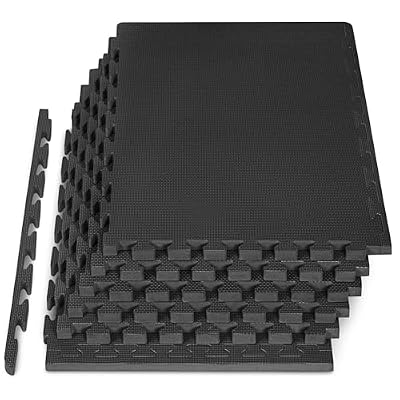 ProsourceFit Extra Thick Exercise Puzzle Mat, 1-inch
- High-density EVA foam tiles, 24 x 24 in and 1 in thick
- 6 tiles and 12 end borders cover 24 sq ft
- Listing warns the surface can compress under heavy equipment
- 5Best for a damp garage
 Rubber-Cal Eco-Sport Interlocking Rubber Tiles, 3/4 in
- 3/4-inch interlocking rubber tiles, 19.5 x 19.5 in each
- 10-pack covers about 28 sq ft
- Pitched for wet, high-traffic areas like gym floors and basements
- 6Best for a light-use zone
 Rubber-Cal Elephant Bark 3/8-inch Rubber Flooring Roll
- 3/8 in x 4 ft x 8 ft sheet
- Made from recycled tire rubber
- For gym floors, equipment mats and basements, indoors or out
Flooring for garage gym setups has to handle one thing most spare rooms don't: a squat rack and a loaded barbell that sometimes drops, sitting on bare concrete in a space that may not be heated. That points to dense rubber for the lifting zone, with lighter tiers where the work is lighter.
The six picks below cover stall mats, rubber tiles, thick foam and a rubber roll. After the picks come the garage-only questions: cold slabs, drains, shared parking space and moving out.
#1. DWC 4 x 6 ft Rubber Mat: best overall for a garage gym
DWC 4 x 6 ft Rubber Mat, 3/4 in
Our verdict:
Best overall for a garage gym
Best for a rack zone where loaded bars come down on concrete.
View on Amazon- 3/4-inch recycled tire rubber, 4 x 6 ft
- About 115 lb per mat
- Cuts with a razor or box cutter; made in Canada
Keep in mind: at about 115 lb per mat, it takes two people to move.
Product details checked September 2026
Standout: a 3/4-inch recycled tire rubber mat of the kind lifting gyms use. It cuts with a razor or box cutter, so you can trim around a post or a drain. Two or three mats cover a typical rack and platform footprint.
#2. American Floor Mats Stall Tiles: best stall rubber in small pieces
American Floor Mats Heavy Duty Stall Tiles, 3/4 in (Set of 9)
Our verdict:
Best stall rubber in small pieces
Best for a garage where you want dense rubber that one person can lay and lift.
View on Amazon- Nine 2 x 2 ft rubber tiles, 0.75 in thick
- Set covers a 6 x 6 ft area
- Wipes or brushes clean
Keep in mind: a set of nine covers 36 square feet, so a full bay takes several sets.
Product details checked September 2026
Standout: 3/4-inch stall-mat rubber in 2 x 2 foot tiles. You can floor just the training zone, then add tiles later. Tiles also let you work around a drain and lift a square to reach it.
#3. American Floor Mats 4 x 6 ft Stall Mat: best US-made stall mat
American Floor Mats 3/4-inch Rubber Stall Mat, 4 x 6 ft
Our verdict:
Best US-made stall mat
Best for a lifting platform or drop zone built from a few large pieces.
View on Amazon- Solid rubber, 3/4 inch thick, 4 by 6 feet
- Made in the US with no rubber substitutes
- Made for heavy equipment
- Wipes or brushes clean
Keep in mind: large and heavy, so check your door and plan a two-person carry.
Product details checked September 2026
Standout: a 3/4-inch solid black stall mat the maker says is made in the US with no rubber substitutes. It is pitched for floor protection under heavy equipment and wipes or brushes clean.
#4. ProsourceFit 1-inch Puzzle Mat: best foam tile for a rack corner
ProsourceFit Extra Thick Exercise Puzzle Mat, 1-inch
Our verdict:
Best foam tile for a rack corner
Best for a garage that wants light, easy-to-cut foam at the heaviest foam tier.
View on Amazon- High-density EVA foam tiles, 24 x 24 in and 1 in thick
- 6 tiles and 12 end borders cover 24 sq ft
- Listing warns the surface can compress under heavy equipment
Keep in mind: the listing notes surface compression under heavy gear, and foam is not a hose-down floor.
Product details checked September 2026
Standout: ProSource rates its 1-inch tile for ultra-heavy gear and high-traffic use (ProSource). It is the closest foam match for a garage with a rack.
#5. Rubber-Cal Eco-Sport Tiles: best for a damp garage
Rubber-Cal Eco-Sport Interlocking Rubber Tiles, 3/4 in
Our verdict:
Best for a damp garage
Best for a garage floor that sees snow melt, rain or the odd flood.
View on Amazon- 3/4-inch interlocking rubber tiles, 19.5 x 19.5 in each
- 10-pack covers about 28 sq ft
- Pitched for wet, high-traffic areas like gym floors and basements
Keep in mind: heavier and slower to lay than foam tiles.
Product details checked September 2026
Standout: 3/4-inch interlocking rubber tiles the maker pitches for wet, high-traffic areas and garage floors. Rubber handles water far better than foam.
#6. Rubber-Cal Elephant Bark Roll: best for a light-use zone
Rubber-Cal Elephant Bark 3/8-inch Rubber Flooring Roll
Our verdict:
Best for a light-use zone
Best for a stretching, cardio or dumbbell area beside the rack zone.
View on Amazon- 3/8 in x 4 ft x 8 ft sheet
- Made from recycled tire rubber
- For gym floors, equipment mats and basements, indoors or out
Keep in mind: at 3/8 inch this is a general-use roll, not the drop-rated tier.
Product details checked September 2026
Standout: a 4 x 8 foot sheet of recycled tire rubber, pitched for gym floors and garage floors. Rubber-Cal describes it as moisture and mold resistant and safe to hose down (Rubber-Cal).
Factors to consider when choosing flooring for garage gym use
A garage adds three questions to the usual load question: the bare slab, the cold and how the space is shared.
Match the heaviest zone first
Among foam tile tiers, the 1-inch thickness is the one ProSource rates for ultra-heavy gear and high-traffic use (ProSource). It is the closest foam match to a garage with a rack and a loaded bar. If part of your garage is for lighter work, like a stretching corner or dumbbells only, the lighter tiers in our flooring for home gym guide fit that zone. You don't have to floor the whole garage in the heaviest option.
Rubber built for drops
Two direct-sold rubber options help set the bar for a drop zone, even though they are not in the picks:
IRON COMPANY rolled rubber, 1/2 inch or 3/4 inch. The maker's warranty language is specific. Only the 1/2-inch and 3/4-inch versions suit heavy drop areas. The thinner 3/8-inch version is not meant as the main surface where plates land (IRON COMPANY). In a garage where drops are likely, that detail matters more than the label "rubber roll."
SurfaceCo stall mats, 3/4 inch. These 4 x 6 foot, 24 square foot mats are re-vulcanized rubber, the same dense material long used for horse stalls and trailers. IRON COMPANY sells them for gym floors because they take so much repeated impact (IRON COMPANY). The DWC and American Floor Mats picks above are the same kind of mat on Amazon.
What changes on concrete
Concrete is already rigid, so a floor on it doesn't need to make up for a flexing subfloor. But concrete passes cold straight through, and a slab in an unheated garage can sit colder than the air above it. None of the listings we read give a cold-slab figure for their standard tile or roll. If your floor gets very cold in winter, ask the maker.
Garages also tend to have a drain or a slight slope for runoff. Tile handles this better than a roll. You can cut single tiles around a drain and lift them to reach it. A roll gets cut once and doesn't reseal as cleanly.
The garage door and temperature
A garage's temperature swing depends a lot on the door. An insulated door and a sealed threshold keep the slab and air closer to a mild range than a thin, uninsulated door. It is not a flooring spec, but it bears on the cold question above. With an uninsulated door and big seasonal swings, you have more reason to ask about cold-weather use before you commit.
What to check before you buy
- Subfloor fit: most tile and roll listings mention concrete, but confirm it on the exact product.
- Drop use: look for a stated fit for dropped weight, not just "heavy duty." The IRON COMPANY note shows why: two thicknesses of one product line suit different jobs.
- Coverage: measure your rack and lifting footprint plus room to move, not the whole garage, unless you want wall-to-wall cover.
- Temperature: in an unheated garage, look for any stated temperature guidance.
- Delivery: a roll or stall mat is heavier and stiffer to move through a door than a stack of 2 x 2 tiles.
How much rubber a rack zone needs
Start from the rack's footprint, then add the space where you stand and where plates land. A rack with a bar loaded in front of it needs rubber under the uprights and a strip in front deep enough for a deadlift or a missed squat. Two 4 x 6 mats side by side give an 8 x 6 foot area, which covers many home racks with room in front. Add a third mat if you pull deadlifts outside the rack.
With 2 x 2 tiles, count squares instead. A set of nine makes a 6 x 6 foot area. Two sets give 72 square feet, which suits a rack plus a small platform. Lay the tiles first, then set the rack on top, so the feet sit on full tiles and not on a seam.
A simple lifting platform
Many garage lifters build a platform from stall mats. The idea is simple. A wood top gives a firm, flat surface for your feet, and rubber strips on each side take the plates when they drop. Plans vary, so follow one from a source you trust and keep the layers flat and tight.
If you don't want to build, two or three stall mats laid flat work as a basic drop zone on their own. They won't feel as firm as wood under your feet, but they protect the slab and quiet the landing.
How we picked flooring for garage gym use
We focused on floors that suit bare concrete and dropped weight, then added lighter options for zones that don't see drops. We compared Amazon listings and maker pages on thickness and material. We also noted the format plus each stated use. IRON COMPANY and SurfaceCo details come from IRON COMPANY's own pages.
We did not test these floors by hand. Every pick has a current Amazon listing we checked, so read it again before you buy.
Zoning a shared garage
Few garages are pure gym space. If yours also parks a car, stores bins or has a workbench, tile has a clear edge over a roll. You can floor just the training footprint and leave the rest bare, then add tiles later if the gym grows. A roll makes more sense once you commit to the whole bay, since cutting a big roll down to an odd shape wastes more material.
If the space has to go back to parking now and then, tile's piece-by-piece design lets you lift a section for a while. A glued or seamless floor doesn't allow that without starting over.
Example: half of a two-car bay
A common layout floors about half of a two-car bay for training and leaves the rest for a car or storage. Stall tiles or 1-inch foam cover the training footprint, and the other half of the slab stays as it was. If a post or a water heater closet cuts into the space, tile handles it far more easily than a roll. You cut single 2-foot pieces around the obstacle instead of fitting one big sheet.
Renting or planning to move
A garage gym is more likely than an indoor room to sit in a rental or a home you plan to leave. Tiles, mats and rolls laid without glue all lift back up and move with you. That is very different from a floor glued or fastened into the slab. If a landlord or a sale is part of the plan, confirm that the product is a dry-lay install with no glue.
How a garage differs from an indoor room
The core choice is the same one covered in our flooring for home gym overview and the best flooring for home gym tile comparison. Match thickness and material to your heaviest real load. What changes in a garage is the subfloor, the climate and the gear mix. Garages hold racks and barbells more often than spare bedrooms, simply because there is more room.
Matching flooring to what happens in the garage
- A rack that stays in one spot for years, with a loaded bar coming in and out: 3/4-inch stall mats or tiles, or the 1-inch foam tile.
- A garage shared with storage or a car: tile, since you can lift sections out or leave parts bare.
- A lifting platform inside a bigger garage: stall mats under just that footprint, with a lighter tier across the rest. This splits the cost and weight.
- A detached, unheated garage through real winters: ask the maker about cold use first, since none of the listings here state a range.
A simple way to work through the choice
- Find your heaviest real load. A rack and loaded bar point to the heavy tiers. Dumbbells and bodyweight work don't need them.
- Mark any true drop zone. Confirm the product's own stated fit for that use, not just its category.
- Walk the slab. Look for cracks and heaving. Note any slope plus the drain spots before you plan the layout.
- Measure the door and path. This matters for rolls and large mats.
- Ask about temperature. Do this if the garage isn't heated, since the listings here don't publish it.
Common mistakes in garage installs
- Laying over an unchecked slab. Cracks or a slope you missed will show through tile or a roll.
- Assuming rubber means drop-rated. As IRON COMPANY's note shows, a 3/8-inch roll and a 3/4-inch roll from the same maker are not the same for a drop zone.
- Covering the drain. Plan cuts or seams around it.
- Skipping the cold question. None of these products publish a cold rating, so ask.
- Underrating delivery. Rolls and stall mats are heavy and stiff. Check the size against your door before you order.
Setup notes for concrete
Foam and rubber tiles generally go down dry, with no glue, over bare concrete, per their makers (ProSource; IRON COMPANY). Rolled rubber goes down the same way. None need a pro installer per these listings. Check that the slab is fairly flat and free of big cracks first, since an uneven slab shows through. Plan the layout around any drain or runoff slope.
New rubber smell
Dense stall-mat rubber often has a strong smell when new, which fades as it airs out. A garage is a better place for that than a bedroom, since you can open the door. Let new mats air out in the garage for a while before daily training on them.
Cleaning a garage gym floor
A garage floor collects more grit than a room indoors. Think tracked-in dirt, tire marks and outdoor dust. Rubber handles that well.
Rubber-Cal describes its roll as moisture and mold resistant and fine to hose down (Rubber-Cal). IRON COMPANY lists good traction when wet for its rolled rubber (IRON COMPANY). That helps if the door stays open in rain or snow. Foam tile isn't built to be hosed down the same way, so check its care notes.
Warranty in a high-traffic garage
A garage floor sees more gear moves and more grit than an indoor room, plus bigger temperature swings. That makes a published warranty worth a look. IRON COMPANY backs its rolled rubber with a 5-year limited warranty against defects (IRON COMPANY). Not every product here states a term, so check the current listing.
Cords, fans and wall fixtures
A garage gym often adds fans, a heater or extra lights. That changes where cords cross the floor. Tile seams give you channels to run a cord along, while a seamless roll leaves a cord as a trip line. If gear needs power mid-room, plan the tile layout or a cord cover before you finish the floor.
The same goes for the door opener's path and any wall-mounted rack hardware you add at the same time. Mark those spots on the bare slab before the first tile goes down. Moving a locked-in section later can damage the edges.
Our verdict on flooring for garage gym setups
The DWC 4 x 6 ft rubber mat is the best flooring for garage gym rack zones where bars come down. American Floor Mats offers the same dense rubber as 2 x 2 tiles and as a US-made 4 x 6 mat. Use ProsourceFit's 1-inch tile if you want foam, and Rubber-Cal's Eco-Sport tiles in a damp garage. Keep the Rubber-Cal roll for lighter zones.
Questions people also ask
Does garage flooring need to differ from indoor room flooring?
The load is often the real difference, not the room. A garage more often holds a squat rack or dropped plates, which points to a heavier tier or rubber made for drops. Beyond load, check that the product suits bare concrete and whether the maker says anything about temperature, since an unheated garage swings further than a heated room.
Do interlocking tiles work directly on a concrete garage floor?
Listings for foam and rubber tiles generally say they suit concrete, wood or carpet. Confirm it on the exact product you buy rather than assuming every listing covers every subfloor the same way.
What thickness fits a typical garage gym?
If a squat rack or heavy dropped plates are part of the plan, look at 3/4-inch rubber stall mats, ProSource's 1-inch foam tile for ultra-heavy gear, or IRON COMPANY's 1/2-inch or 3/4-inch rolled rubber. Lighter zones for bodyweight or dumbbell work can use a thinner tier.
Does a garage's temperature range affect which flooring to buy?
It can. None of the makers we read publish a cold-weather rating for their standard tile or roll. Rubber tends to stiffen in cold and soften in heat more than foam. If your garage stays unheated through a hard winter, ask the maker about the product's temperature range before you buy.
Can I use horse stall mats in a garage gym?
Yes. Stall mats are dense rubber built for barns and trailers, and gyms use them for the same toughness. IRON COMPANY sells SurfaceCo's 4 x 6 ft mats for gym floors (IRON COMPANY). A single mat is usually a two-person carry, so plan for that when it arrives.