
8 Best Squat Racks, Power Racks and Smith Machines for Home Gyms in 2026
As an Amazon Associate, this website earns from qualifying purchases.
The short answer
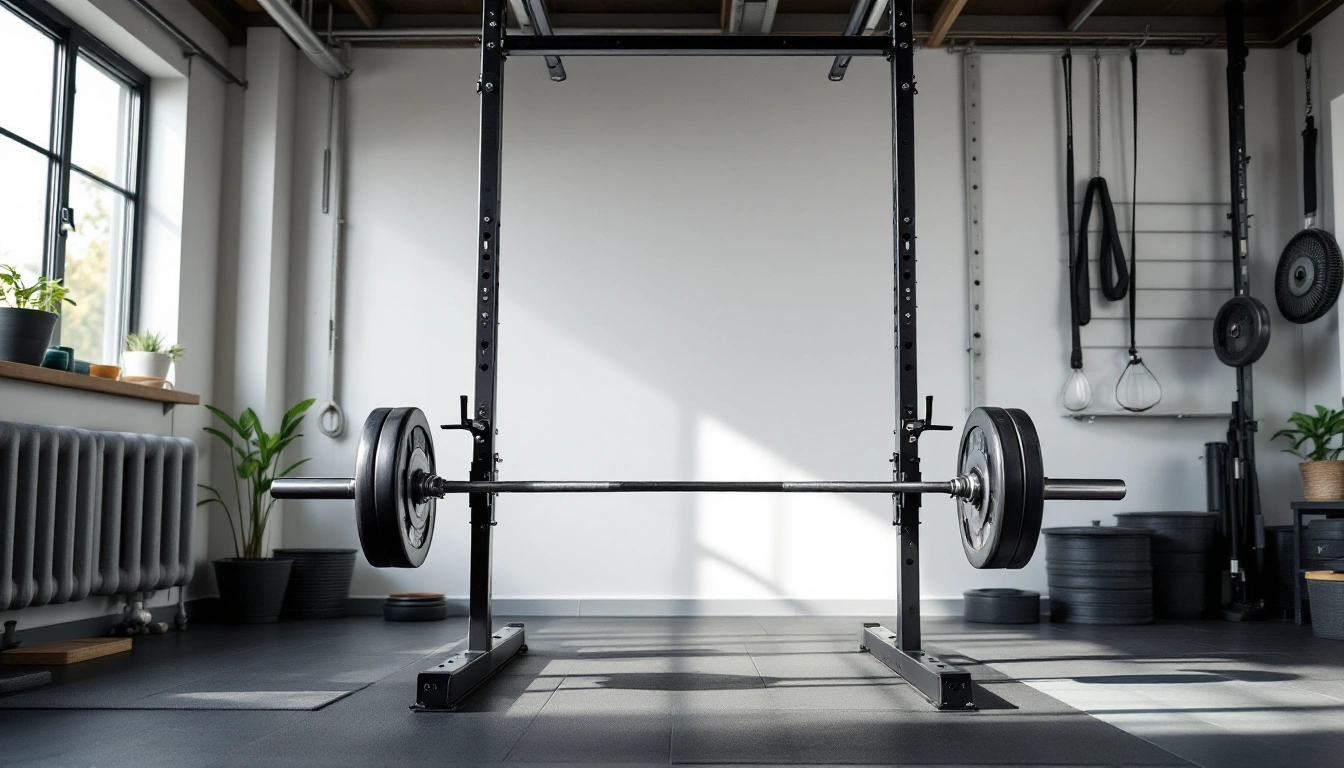
For most home gyms the Titan T-3 power rack is the best pick, since it keeps a free bar path and runs safeties through the cage. Add the Titan T-3 Smith attachment if you also want a guided bar, or pick the Titan T-3 squat stand for the smallest footprint.
Last updated September 2026
Contents12
- #1. Titan T-3 Power Rack: best power rack
- #2. Sunny Health & Fitness Full Size Power Cage: best cage with numbered settings
- #3. Titan T-3 Tall Squat Stand: best squat stand
- #4. Titan T-3 Short Squat Stand: best for low ceilings
- #5. Titan Fitness Smith Machine: best standalone Smith machine
- #6. Titan T-3 Smith Machine Rack Attachment: best Smith add-on
- #7. Mikolo M4 2.0 Lite: best all-in-one Smith and cable station
- #8. Titan T-3 Folding Power Rack: best folding rack
- Factors to consider when choosing a squat smith machine vs power rack
- How we picked the squat smith machine vs power rack picks
- More in this guide
- Our verdict on squat smith machine vs power rack
Our top 8 picks
- 1Best power rack
 Titan Fitness T-3 Series Tall Power Rack, 24 in Depth
- Four-post cage with 24 inch side braces
- Listing names a 1,100 lb capacity; J-hooks rated to a combined 1,000 lb
- Two pull-up bars, 1.25 inch and 2 inch
- 2Best cage with numbered settings
 Sunny Health & Fitness Full Size Power Cage
- 14-gauge steel frame
- Listed at 2,130 lb total combined capacity
- 18 numbered levels for J-hooks and spotter arms
- 3Best squat stand
 Titan Fitness T-3 Series Tall Squat Stand with Pull-Up Bar
- 92.5 inches tall with a bolt-on pull-up bar
- 2x3 inch steel uprights
- J-hooks rated to 1,000 lb
- 4Best for low ceilings
 Titan Fitness T-3 Series Short Squat Stand
- 73.5 inches tall, sized for low ceilings
- Needs no floor bolts
- J-hooks rated to 1,000 lb
- 5Best standalone Smith machine
 Titan Fitness Counterbalanced Smith Machine
- Guided bar on linear bearings with two adjustable safety catches
- Counterweight makes the empty bar lighter than its own weight
- J-hook plates with 8 positions
- 6Best Smith add-on
 Titan Fitness T-3 Series 91-inch Smith Machine Rack Attachment
- Adds a guided Smith bar to a 91 inch T-3 power rack
- Rated to 500 lb
- Comes with the bar, guide rods, safety stops and spotter hooks
- 7Best all-in-one Smith and cable station
 Mikolo M4 2.0 Lite Smith Machine and Functional Trainer
- Smith machine, squat rack, pull-up station and dual cables in one frame
- 117 lb weight stack on each side
- About 87 in tall, 70.86 in long and 73.8 in wide
- 8Best folding rack
 Titan Fitness T-3 Series Wall-Mounted Folding Power Rack, 82 in x 21 in
- Swings flat against the wall when you are done
- 2x3 inch, 11-gauge steel uprights with Westside hole spacing
- J-hooks rated to 1,000 lb, pull-up bar included
Squat smith machine vs power rack is not a question of which one is best. The three are not tiers of one product. They are three different ways to hold a bar, and the right one depends on how you want the bar to move and how much space you have.
A squat rack or squat stand is two uprights holding J-cups, with a free bar path. A power rack is the same free bar path inside a closed four-post frame. That frame lets it carry the highest loads and run safety pins through the middle of a lift. A Smith machine gives up the free bar path. The bar rides a fixed track on linear bearings, in return for built-in catches and less balance demand.
So this page ranks real picks across all three types. The Factors section below explains the mechanical differences, from bar path to footprint and safeties. Two deeper guides cover specific cases: a garage gym squat rack for tight garages, and power rack vs. squat rack for that one choice.
#1. Titan T-3 Power Rack: best power rack
Titan Fitness T-3 Series Tall Power Rack, 24 in Depth
Our verdict:
Best power rack
Best for free-bar squats, bench and pulls at real working weight, often alone.
View on Amazon- Four-post cage with 24 inch side braces
- Listing names a 1,100 lb capacity; J-hooks rated to a combined 1,000 lb
- Two pull-up bars, 1.25 inch and 2 inch
- Westside hole spacing through the bench and pull zones
Keep in mind: the tall model needs a high ceiling, and a four-post cage takes the most floor.
Product details checked September 2026
Standout: Four posts mean safeties can run through the cage. Titan sells an extension kit and a Smith attachment for this rack, so it can grow later.
#2. Sunny Health & Fitness Full Size Power Cage: best cage with numbered settings
Sunny Health & Fitness Full Size Power Cage
Our verdict:
Best cage with numbered settings
Best for newer lifters who want easy J-hook and spotter arm setup.
View on Amazon- 14-gauge steel frame
- Listed at 2,130 lb total combined capacity
- 18 numbered levels for J-hooks and spotter arms
- Reversible pull-up bar
Keep in mind: its 14-gauge frame is thinner steel than the 11-gauge Titan.
Product details checked September 2026
#3. Titan T-3 Tall Squat Stand: best squat stand
Titan Fitness T-3 Series Tall Squat Stand with Pull-Up Bar
Our verdict:
Best squat stand
Best for a small gym that wants squats, bench and pull-ups without a full cage.
View on Amazon- 92.5 inches tall with a bolt-on pull-up bar
- 2x3 inch steel uprights
- J-hooks rated to 1,000 lb
- Needs no floor bolts
Keep in mind: with no rear posts it can't run pin safeties, so add spotter arms.
Product details checked September 2026
Standout: It needs no floor bolts, per the listing. At 92.5 inches tall, though, it needs a ceiling well over 8 feet if you want to use the pull-up bar.
#4. Titan T-3 Short Squat Stand: best for low ceilings
Titan Fitness T-3 Series Short Squat Stand
Our verdict:
Best for low ceilings
Best for basements and garages under 8 feet.
View on Amazon- 73.5 inches tall, sized for low ceilings
- Needs no floor bolts
- J-hooks rated to 1,000 lb
- Takes optional T-3 spotter arms
Keep in mind: no pull-up bar, and it keeps its floor spot all week.
Product details checked September 2026
#5. Titan Fitness Smith Machine: best standalone Smith machine
Titan Fitness Counterbalanced Smith Machine
Our verdict:
Best standalone Smith machine
Best for solo training with less balance demand, or guided squats and presses.
View on Amazon- Guided bar on linear bearings with two adjustable safety catches
- Counterweight makes the empty bar lighter than its own weight
- J-hook plates with 8 positions
- Pull-up bar, band pegs and six plate posts
Keep in mind: the frame is wide, at 67 inches, or 75 with the weight sleeves.
Product details checked September 2026
Standout: The counterweight means the empty bar feels lighter than its own weight. That helps beginners and anyone coming back from a layoff.
#6. Titan T-3 Smith Machine Rack Attachment: best Smith add-on
Titan Fitness T-3 Series 91-inch Smith Machine Rack Attachment
Our verdict:
Best Smith add-on
Best for owners of a 91 inch Titan T-3 power rack who want a guided bar too.
View on Amazon- Adds a guided Smith bar to a 91 inch T-3 power rack
- Rated to 500 lb
- Comes with the bar, guide rods, safety stops and spotter hooks
- Fits front, back or extension uprights
Keep in mind: it only fits the 91 inch T-3 rack, and it is rated to 500 lb.
Product details checked September 2026
Standout: This is the most space-efficient way to get both bar paths. The Smith bar mounts inside the rack you already own.
#7. Mikolo M4 2.0 Lite: best all-in-one Smith and cable station
Mikolo M4 2.0 Lite Smith Machine and Functional Trainer
Our verdict:
Best all-in-one Smith and cable station
Best for a dedicated room that wants a rack, Smith bar and cables in one frame.
View on Amazon- Smith machine, squat rack, pull-up station and dual cables in one frame
- 117 lb weight stack on each side
- About 87 in tall, 70.86 in long and 73.8 in wide
- 34 height settings on 2 inch spacing
Keep in mind: at about 74 inches wide it needs more floor than any other pick here.
Product details checked September 2026
#8. Titan T-3 Folding Power Rack: best folding rack
Titan Fitness T-3 Series Wall-Mounted Folding Power Rack, 82 in x 21 in
Our verdict:
Best folding rack
Best for a garage that still parks a car and has studs in the right place.
View on Amazon- Swings flat against the wall when you are done
- 2x3 inch, 11-gauge steel uprights with Westside hole spacing
- J-hooks rated to 1,000 lb, pull-up bar included
- Wall-mounting hardware is not in the box
Keep in mind: wall hardware is not in the box.
Product details checked September 2026
Factors to consider when choosing a squat smith machine vs power rack
Bar path: the real mechanical difference
This is the one spec that separates all three. Understand it before footprint or price.
Squat rack and power rack: free bar path. The bar isn't attached to the frame. It rests in J-cups when racked. Once you lift it off, it moves however your body moves it, forward and back along whatever arc your lift makes. This is the same bar path as a barbell lift anywhere else. That is why competitive lifters train in a rack, not a Smith machine.
Smith machine: fixed, guided bar path. A carriage on linear bearings ties the bar to a track on the frame. Titan Fitness describes its Smith machine as a smooth, guided track using a linear-bearing carriage (Titan Fitness). Some Smith machines run a straight vertical track. Others angle slightly to copy a natural bar path. None let the bar move apart from the track.
That one difference is why the three are not interchangeable for every lift. A back squat, front squat or free-bar bench trains the stabilizers that keep an unguided bar balanced. A Smith machine removes that demand by design. Some lifters want that: more load, less balance risk and safer solo work. Others avoid it because it carries over less to free lifting.
Footprint and clearance by type
Footprints vary by depth and height option. Here is what real models list.
- Squat stand: Rogue's SML-2 Monster Lite takes 49 by 48 inches and stands 92.25 inches tall. Floor mounting is optional (Rogue Fitness). Titan's T-3 stands come at 73.5 or 92.5 inches tall and need no bolts, per their listings.
- Bolt-down power rack: Rogue's RML-390 3.0 is 34 by 53 inches at a 24 inch depth, or 40 by 53 inches at 30 inches. It comes 80.375 or 90.375 inches tall, and Rogue says it must be bolted down (Rogue Fitness).
- Modular-depth power rack: REP Fitness's PR-4000 is 50.8 inches wide with 16, 24, 30 or 41 inch depths, at 80 or 93 inches tall. Optional back storage adds 16 inches (REP Fitness).
- Low-ceiling power rack: Titan's T-3 line comes at 82 inches tall. Its 24 inch depth frame is 46 by 30 inches outside with 42 inches inside (Titan Fitness).
- Standalone Smith machine: Titan's Smith machine is 67 inches wide, or 75 with weight sleeves, by 54 inches deep and 86 inches tall. It needs no separate rack (Titan Fitness).
- Smith rack attachment: REP's Smith Machine Rack Attachment mounts onto a PR-4000 or PR-5000 (REP Fitness). Titan's fits its 91 inch T-3 rack. Neither adds its own footprint.
- Folding wall rack: PRx's Profile PRO with no pull-up bar folds to 52 inches wide and 26.75 down to 9 inches deep, depending on stage. It needs a stud wall and a ceiling of 86 to 100 inches (PRx Performance).
Two things stand out from that list. First, a standalone Smith machine is not always smaller than a power rack.
It is often a similar or larger frame, because the guided track needs its own enclosure. What it saves is a second piece of gear. Second, a rack-mounted Smith attachment adds close to nothing to a rack's footprint. It is the most space-efficient way to get a guided bar if you own a power rack.
Folding wall racks store smallest. PRx's Profile PRO folds to as little as 9 inches deep in its simplest form. That only works if your wall has a long enough stud run and your ceiling clears the stated minimum.
Safety systems: pins, straps, arms and Smith catches
Power racks run safety gear through the closed frame. There are three common types:
- Pin or pipe safeties are solid metal bars that span front to back through the uprights. They stop a bar at a fixed height with a hard, metal-on-metal catch (Bells of Steel).
- Strap safeties are fabric straps set to catch height. They soften the drop and can sit at slightly different heights front and back (Bells of Steel).
- Flip-down spotter arms flip up out of the way during a lift and down to catch height, often with a liner. REP's PR-4000 offers all three as options (REP Fitness).
Squat stands have two separate uprights with nothing linking them front to back. So they generally can't run pins through the middle. Rogue's SML-2 ships with J-cups and offers spotter arms that bolt to the front posts as an add-on (Rogue Fitness). Titan's T-3 stands take optional T-3 spotter arms, per their listings.
Smith machines don't use rack pins or straps. The track already holds the bar, so safety comes from adjustable catches on the frame. Titan's Smith machine lists two adjustable safety catches plus J-hook plates with eight drop positions (Titan Fitness). That is part of why people suggest a Smith machine for solo work. The bar can't fall sideways or forward, only down onto its catches.
Steel gauge and hole spacing
Most racks in this comparison use the same kind of steel. 11-gauge, 3x3 inch uprights show up on Rogue's RML-390, REP's PR-4000 and PRx's Profile PRO (Rogue Fitness; REP Fitness; PRx Performance). Titan's T-3 uses a smaller 2x3 inch upright at the same 11-gauge thickness (Titan Fitness). The Sunny cage lists a 14-gauge frame. So in this size class, the big differences are usually the footprint and safeties, not the steel.
Hole spacing is the other detail. It sets how finely you can place J-cups and safeties. Most of these racks use Westside spacing: 1 inch holes through the bench and pull zones, and 2 inch spacing above and below. Rogue's RML-390, REP's PR-4000 and Titan's T-3 all use it (Rogue Fitness; REP Fitness; Titan Fitness). Tighter spacing in the working zone gives finer bar height on presses and pulls.
Which one fits which goal
- Free-bar lifts at real weight, maybe alone: a power rack with pin or strap safeties gives a free bar path and the surest catch.
- Smallest freestanding footprint, no wall mounting: a squat stand. Rogue's SML-2 and Titan's T-3 stands need no floor bolts or wall studs.
- Smallest stored footprint, with a good wall and ceiling: a folding wall rack like PRx's Profile line or Titan's T-3 folding rack.
- Solo training with less balance demand, or guided rehab-style work: a Smith machine, standalone or as a rack add-on.
- Both a free and a guided bar without two frames: a Smith attachment on a power rack, like Titan's or REP's.
How a folding wall rack folds
Folding racks use more than one design, and that changes how the fold feels day to day. PRx's Profile PRO uses a patented fold-up design with hydraulic shocks at the pivots. You pull the uprights away from the wall and they lock in place. To fold, you release the lock pins and push the frame flat, where it stores about 4 inches deep (PRx Performance).
The shocks do real work. A bare steel frame this size would be heavy to fold by hand.
The wall side has its own need. PRx's brackets mount to studs 16 or 24 inches on center. If your studs land between those or are uneven, PRx requires a ledger board (PRx Performance). So find your studs before you buy, and budget for a ledger board if they don't line up.
A freestanding squat stand or power rack has no fold and no stud need. It just needs a flat floor that can take the load. The fold buys a much smaller stored footprint. It costs a framing requirement and a hinge system a freestanding rack doesn't have.
Room by room: what fits where
A studio or a small corner of about 6 by 6 feet, rented, no drilling: A freestanding squat stand is close to the only choice. A stand like Rogue's SML-2 at 49 by 48 inches fits without bolts. A standalone Smith machine at 67 to 75 inches wide by 54 deep usually won't fit once you add clearance.
A one-car garage, half for training, owned, drillable walls: This is the case a folding wall rack is made for. It folds to a few inches deep, leaving the floor for a car. That only works if the wall has a usable stud pattern and the ceiling clears 86 to 100 inches, depending on the model.
A dedicated garage gym with no car: A bolt-down power rack is the plain choice here. You don't need the floor back between sessions. Rogue's RML-390 must be bolted down for rated stability, which is no problem in a room that stays a gym.
A finished basement or spare room where guided movement matters: A Smith machine, standalone or as a rack add-on, makes sense if training without a spotter worries you. Its catches stop a bar from tipping sideways. A rack's pins or straps don't fully guard against that on off-balance reps.
Clearance is a separate number from footprint
Footprint numbers are the gear's own size, not the room it needs. A rack 40 inches wide on paper needs far more than 40 inches of floor. You need room to load plates, walk a bar out and step back.
RitFit's home gym planning guide gives working numbers to start from. It suggests 2 to 3 feet of clearance around all open sides of a rack. It adds 1.5 to 2 feet at each sleeve end for loading a 7 foot bar, and 3 feet in front for walkouts (RitFit). On a 40 by 53 inch rack, that means about 8 to 9 feet in one direction once you add loading room on both sides.
The three types differ here again. A power rack's safeties let you lift inside the frame, so you mostly need room at the ends and in front. A squat stand with spotter arms needs room in front of the arms too. A Smith machine's bar can't drift sideways or forward. So its clearance is more predictable: loading room at the ends and a step-in zone.
Measure your room against these clearance numbers, not the rack's stored size, before you assume it fits. Tape the full working area on the floor and walk through a squat, a bench setup and a plate change inside it.
Combination units
Some makers build a Smith machine and a cable system into a rack frame. REP Fitness's Summit trainer with its Ares 2.0 attachment combines a cable system, Smith machine and half rack in one 4-post footprint. REP says a purpose-built crossmember means you don't need a much bigger 6-post rack to get all three (REP Fitness).
The Mikolo M4 2.0 Lite is another all-in-one, with a Smith bar and two 117 lb stacks. A combo frame gets both bar types without a second unit's floor space. The cost is being tied to one maker's add-ons.
Ongoing costs and care
Prices across all three types vary with the steel, the size and the safeties included. Check current listings rather than trusting a number here.
A few costs apply at any price. A bolt-down power rack needs floor anchors, and some models need a slab, not a plywood subfloor.
A folding wall rack needs a stud run at the exact height and width the model wants. That sometimes means opening a wall to add blocking. A Smith machine's linear-bearing track is a moving part. It benefits from the same cleaning and light oil any linear slide needs.
Overhead clearance and pull-up bars
Height on a spec sheet is the rack's own size, not the ceiling you need. Three numbers matter, and they are easy to mix up.
Upright height is the frame's top. Rogue's RML-390 comes in 80.375 or 90.375 inch uprights, and REP's PR-4000 in 80 or 93 inches (Rogue Fitness; REP Fitness). It is not your minimum ceiling on its own.
Minimum ceiling height is what the maker recommends for the room. It is usually a few inches taller than the upright, to leave room for pull-ups. PRx lists minimum ceilings of 86 to 100 inches across its Profile PRO heights (PRx Performance). That gap is pull-up clearance, not slack.
Working overhead clearance is what a lift needs above the bar. An overhead press or a snatch needs room for the bar and plates to go well above your head. If you train overhead, check that number against your real ceiling. Count any duct or door track that hangs low.
A Smith machine skips some of this because the track has a fixed top. Titan's standalone Smith machine is 86 inches tall. Measure your ceiling against that number (Titan Fitness).
Common mistakes when choosing between the three
Buying a Smith machine because it seems safer, without checking your goal. A fixed track is safer for solo and guided work, but it changes what the lift trains. For powerlifting, Olympic lifting or general free-bar strength, a Smith machine doesn't build the same balance, however heavy you load it.
Assuming folding always means the smallest footprint. A folding rack stores flat, but only after you confirm the studs and ceiling. A freestanding squat stand can take less total space than a folding rack whose wall needs a ledger board workaround.
Comparing width or depth without checking the exact model. One product line often ships in several depths and heights. REP's PR-4000 spans 16 to 41 inches of depth (REP Fitness). Compare the exact version you are buying.
Skipping a required floor bolt. Some racks, like Rogue's RML-390, must be bolted down for rated stability (Rogue Fitness). Treat that as a real install step, with anchors into a slab.
What to check before you buy any of the three
- Bar path: free (squat rack, power rack) or fixed (Smith machine). This decides what the gear trains.
- Footprint at your exact depth and height. Check the model you are buying, not the product family.
- Floor or wall mounting. Some racks must be bolted down. Folding wall racks need a stud run and a minimum ceiling.
- Safety type: pins, straps, spotter arms or Smith catches, and whether they are included.
- Weight rating. REP's PR-4000 lists a 1,000 lb rackable capacity, while REP's Smith attachment is rated to 450 lb (REP Fitness). Titan's T-3 Smith attachment is rated to 500 lb. Don't assume a Smith add-on shares its host rack's number.
How we picked the squat smith machine vs power rack picks
We picked at least two real options for each type: power rack, squat stand and Smith machine. We added a folding rack for shared garages. For each one we read the Amazon listing and the maker's spec pages.
We checked bar path, footprint, height, safeties, rated load and mounting. We kept Rogue, REP and PRx specs from our older guide as comparison points where we could not verify an Amazon listing. We did not test this gear by hand. Check the current listing before you buy.
More in this guide
- Best Garage Gym Squat Racks: folding and freestanding racks for a garage, plus low-ceiling picks.
- Power Rack vs. Squat Rack: how structure and safety differ for that one choice.
For a bench to pair with any rack, see folding weight benches. For more fold-flat racks, see the folding squat rack picks.
Our verdict on squat smith machine vs power rack
In the squat smith machine vs power rack choice, most home gyms do best with a power rack like the Titan T-3. It keeps a free bar path and lets safeties catch a failed lift. Add the Titan T-3 Smith attachment if you want a guided bar too, or pick the Titan Smith machine as a standalone. Choose a Titan T-3 squat stand for the smallest footprint, and the Titan T-3 folding rack if the garage still parks a car.
Our picks in this topic
5 picks
5 Best Garage Gym Squat Racks for Low Ceilings and Shared Bays in 2026
Five garage gym squat racks compared: folding wall racks, a no-bolt squat stand and low-ceiling racks, with the stud, ceiling and floor checks that decide the fit.
Questions people also ask
Is a Smith machine as good as a power rack for squats?
It does a different job, not a worse one. A power rack keeps the bar path free, so the bar moves however your body moves it, the same as an unassisted barbell squat. A Smith machine locks the bar to a fixed track on linear bearings, which takes balance and stabilizer demand out of the lift. Titan Fitness's Smith machine uses exactly this: a guided track with a linear-bearing carriage (Titan Fitness). For free-bar squats, bench or Olympic lifts, a power rack matches the pattern. For loading a squat or press with less balance demand, or training alone, a Smith machine's fixed track and built-in catches can be the safer choice.
Can a Smith machine replace a squat rack in a small garage gym?
For squats and presses inside the frame, yes, since a Smith machine is a self-contained station. It won't replace a rack for free-bar work like Olympic lifts or free-bar bench. REP Fitness and Titan Fitness both sell a Smith attachment that mounts onto an existing power rack, which gets you both in about one footprint (REP Fitness; Titan Fitness).
What's the difference between a squat rack and a power rack?
Structure and safety coverage. A squat rack, often called a squat stand, uses two separate uprights with J-cups. Nothing connects front to back, so it can't run safety pins through the middle. A power rack is a closed four-post frame, which lets you run pins or straps right through it and catch a bar anywhere inside. Squat stands use spotter arms that bolt to the front posts instead. Rogue's SML-2 ships with J-cups and takes spotter arms as an add-on (Rogue Fitness).
Do folding or wall-mounted racks give up capacity or safety?
Not always, but they trade floor space for wall access. PRx Performance's Profile PRO folds up against a wall to as little as 9 inches deep in its no pull-up bar version, and opens to about 52 inches wide. Every version needs a stud-mounted wall run and a minimum ceiling of 86 to 100 inches, depending on the model (PRx Performance). Check the exact model's numbers before you assume it fits.
Which is best for a beginner lifting at home?
It depends on the goal. A beginner who wants to learn free barbell lifts does well in a power rack with safeties set just below the bottom of each rep. A beginner who mainly wants guided squats and presses alone may prefer a Smith machine. Titan's counterbalanced Smith bar starts lighter than its own weight, which helps early on. Either way, learn to set the safeties before you add real weight.