
5 Best Garage Gym Squat Racks for Low Ceilings and Shared Bays in 2026
As an Amazon Associate, this website earns from qualifying purchases.
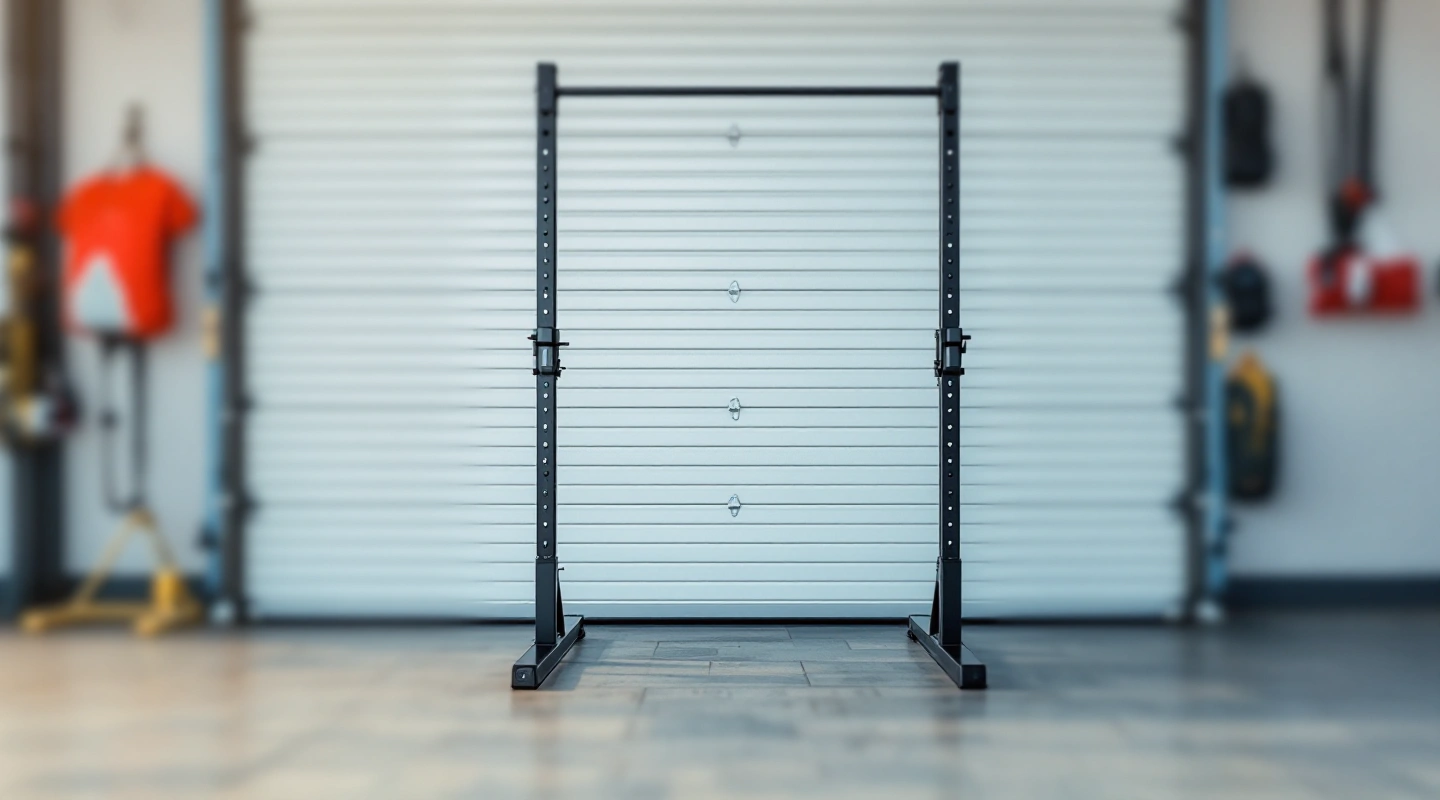
The short answer
The Titan T-3 folding rack is the best garage gym squat rack if you have studs and still park a car. With no drillable wall, the Titan T-3 short squat stand is the pick.
Last updated September 2026
Contents8
- #1. Titan T-3 Folding Power Rack: best for a shared garage
- #2. PRx Profile PRO 73 inch: best folding rack for a low garage ceiling
- #3. Titan T-3 Short Squat Stand: best with no drilling
- #4. Titan T-3 Space Saving Rack 82 inch: best low-ceiling rack
- #5. Titan T-3 Power Rack: best full cage for a garage that is all gym
- Factors to consider when choosing a garage gym squat rack
- How we picked the best garage gym squat racks
- Our verdict on the garage gym squat rack
Our top 5 picks
- 1Best for a shared garage
 Titan Fitness T-3 Series Wall-Mounted Folding Power Rack, 82 in x 21 in
- Swings flat against the wall when you are done
- 2x3 inch, 11-gauge steel uprights with Westside hole spacing
- J-hooks rated to 1,000 lb, pull-up bar included
- 2Best folding rack for a low garage ceiling
 PRx Performance Profile PRO 73-inch Folding Squat Rack
- Wall-mounted rack that folds up on gas shocks
- Needs about 91 in of ceiling to fold; lower with a modified install
- 3x3 11-gauge steel, J-cups hold 600 lb
- 3Best with no drilling
 Titan Fitness T-3 Series Short Squat Stand
- 73.5 inches tall, sized for low ceilings
- Needs no floor bolts
- J-hooks rated to 1,000 lb
- 4Best low-ceiling rack
 Titan Fitness T-3 Series Space Saving Rack, 82 in x 12 in
- 82 inches tall with a 12 inch depth
- Wall-anchored rack with 2x3 inch, 11-gauge uprights
- J-hooks rated to 1,000 lb, pull-up bar included
- 5Best full cage for a garage that is all gym
 Titan Fitness T-3 Series Tall Power Rack, 24 in Depth
- Four-post cage with 24 inch side braces
- Listing names a 1,100 lb capacity; J-hooks rated to a combined 1,000 lb
- Two pull-up bars, 1.25 inch and 2 inch
A garage gym squat rack has a harder job than a rack in a spare room. The garage may still need to fit a car, a workbench or storage the rest of the week. So the key spec is not only weight capacity. It is whether the rack needs floor bolts, a set stud pattern or ceiling height you may not have.
This page covers the three realistic types for a garage. Freestanding squat stands need no wall or floor work. Folding wall racks store smallest but depend on the wall. Short racks are built for garages under 8 feet. For the wider look at racks versus a Smith machine, see the squat rack vs. Smith machine vs. power rack hub. For rack versus stand alone, see power rack vs. squat rack.
#1. Titan T-3 Folding Power Rack: best for a shared garage
Titan Fitness T-3 Series Wall-Mounted Folding Power Rack, 82 in x 21 in
Our verdict:
Best for a shared garage
Best for a garage that still parks a car and has studs in the right place.
View on Amazon- Swings flat against the wall when you are done
- 2x3 inch, 11-gauge steel uprights with Westside hole spacing
- J-hooks rated to 1,000 lb, pull-up bar included
- Wall-mounting hardware is not in the box
Keep in mind: wall hardware is not in the box, so budget for lag bolts or a stringer.
Product details checked September 2026
Standout: You pull the rack out to train and fold it back to the wall to park. Titan sells it in 82 and 91 inch heights, so there is a size for an average garage ceiling.
#2. PRx Profile PRO 73 inch: best folding rack for a low garage ceiling
PRx Performance Profile PRO 73-inch Folding Squat Rack
Our verdict:
Best folding rack for a low garage ceiling
Best for garages where the door track hangs low.
View on Amazon- Wall-mounted rack that folds up on gas shocks
- Needs about 91 in of ceiling to fold; lower with a modified install
- 3x3 11-gauge steel, J-cups hold 600 lb
Keep in mind: the J-cups hold 600 lb, lower than the Titan racks.
Product details checked September 2026
Standout: PRx uses a patented fold-up design with gas shocks at the pivots. You release the lock pins and push the frame flat to the wall (PRx Performance). The wall brackets need studs 16 or 24 inches on center, or a ledger board if they are uneven.
#3. Titan T-3 Short Squat Stand: best with no drilling
Titan Fitness T-3 Series Short Squat Stand
Our verdict:
Best with no drilling
Best for renters and anyone who can't bolt into a wall or slab.
View on Amazon- 73.5 inches tall, sized for low ceilings
- Needs no floor bolts
- J-hooks rated to 1,000 lb
- Takes optional T-3 spotter arms
Keep in mind: it does not fold, so it keeps its floor spot all week.
Product details checked September 2026
Standout: At 73.5 inches tall it fits under most garage door tracks. It needs no floor bolts, per the listing. Add Titan's T-3 spotter arms if you squat heavy alone.
#4. Titan T-3 Space Saving Rack 82 inch: best low-ceiling rack
Titan Fitness T-3 Series Space Saving Rack, 82 in x 12 in
Our verdict:
Best low-ceiling rack
Best for garages with a ceiling close to 7 feet that want a rack with a pull-up bar.
View on Amazon- 82 inches tall with a 12 inch depth
- Wall-anchored rack with 2x3 inch, 11-gauge uprights
- J-hooks rated to 1,000 lb, pull-up bar included
- Wall hardware not included; bottom braces optional
Keep in mind: it anchors to the wall and does not fold, so it always sticks out 12 inches plus the J-hooks.
Product details checked September 2026
#5. Titan T-3 Power Rack: best full cage for a garage that is all gym
Titan Fitness T-3 Series Tall Power Rack, 24 in Depth
Our verdict:
Best full cage for a garage that is all gym
Best for a garage that no longer parks a car.
View on Amazon- Four-post cage with 24 inch side braces
- Listing names a 1,100 lb capacity; J-hooks rated to a combined 1,000 lb
- Two pull-up bars, 1.25 inch and 2 inch
- Westside hole spacing through the bench and pull zones
Keep in mind: the tall model needs a high ceiling, and a cage takes the most floor.
Product details checked September 2026
Standout: Four posts let you run safeties right through the rack. That gives a catch point under the bar almost anywhere inside the frame.
Factors to consider when choosing a garage gym squat rack
Freestanding squat stands
A freestanding squat stand is the simplest choice for a garage where you can't drill. That covers renters, shared walls and stud patterns that don't line up.
Rogue's SML-2 Monster Lite Squat Stand is a plain example. It has a 49 by 48 inch footprint, stands 92.25 inches tall and is rated to 1,000 lb or more. Floor mounting is optional, since the footprint is wide enough for typical squat and strict pull-up training (Rogue Fitness). Rogue sells optional mounting feet if you want more hold for kipping pull-ups or heavy spotter arm use. Rogue sells direct, not on Amazon, so the Titan stand is our pick.
The trade-off is stored footprint. A squat stand doesn't fold, so its idle footprint is its training footprint. That is roughly 4 by 4 feet of floor, all the time. Pick this type when you can't mount to a wall and you'd rather keep a fixed spot.
Folding wall racks
If your garage wall has studs in the right places, a folding rack comes closest to vanishing. It stores against the wall and leaves the floor for a car.
Titan's T-3 folding rack is 2x3 inch, 11-gauge steel with J-hooks rated to 1,000 lb, per the listing. The listing notes that the included hardware is for assembly only, not for the wall. Budget for lag bolts or anchors rated for your wall.
Check two things before you buy. First, your real stud spacing, measured and not assumed. Second, your ceiling's clearance for the height you pick. PRx lists 86 to 100 inches across its Profile PRO height options (PRx Performance).
Short racks for garages under 8 feet
A standard rack's 90 plus inch uprights won't fit under many garage ceilings. Insulation, drywall or a door track can eat into the stated height. Titan's T-3 line comes in 82 inch and 91 inch heights. An 82 inch rack in an 84 inch ceiling leaves only about 2 inches. That is enough to stand the rack up but not for pull-ups, so measure your exact ceiling first.
If your garage has a low ceiling and no wall for a folding rack, a short squat stand is the middle ground. The Titan T-3 short stand is 73.5 inches tall and needs no bolts.
Choosing between the three
- Renting, no drilling, or unsure about studs: a freestanding squat stand. No wall or floor work needed.
- Garage doubles as parking and you have drillable studs: a folding wall rack. Confirm stud spacing and ceiling clearance first.
- Ceiling under 8 feet: a short rack or stand made for that height. Don't assume a tall rack's short option will clear.
- Want the most rated capacity and don't need the floor back: a bolt-down power rack, covered on the power rack vs. squat rack page.
What to measure before buying
- Stud spacing on the wall you're using. Use a stud finder. 16 or 24 inches on center is standard, but check it.
- Ceiling height at the exact spot. Count any duct, light or garage door track that hangs lower than the ceiling.
- Whether floor bolts are required or optional for the model. Some racks say bolts are a must for rated stability. Others list them as optional.
- Folded and open footprint for a folding model. The open, training footprint needs its own clear space too.
How we picked the best garage gym squat racks
We sorted racks by the three garage problems: no wall, a shared floor and a low ceiling. Then we read each Amazon listing and the maker's spec pages for height, depth, J-hook rating and mounting needs. We only picked racks with a verified Amazon listing. Rogue models appear in the text for comparison only. We did not test these racks by hand, so check the current listing before you buy.
Our verdict on the garage gym squat rack
The Titan T-3 folding rack is the best garage gym squat rack for a garage that still parks a car. For a low ceiling, pick the PRx Profile PRO 73 inch or the Titan T-3 82 inch space saving rack. If you can't drill at all, get the Titan T-3 short squat stand. For more folding picks, see the folding squat rack guide.
Questions people also ask
Do I need to bolt a garage gym squat rack to the floor?
It depends on the model. Rogue's RML-390 power rack states the unit must be bolted to the floor for rated stability (Rogue Fitness). Squat stands are often different. Rogue's SML-2 lists floor mounting feet as an optional add-on, since its 49 by 48 inch footprint is wide enough to stand on its own for typical training (Rogue Fitness). Titan's T-3 squat stands also need no floor bolts, per their listings. Folding wall racks skip floor bolts and rely on the wall mount.
Can I put a folding squat rack on a wall without studs at 16 inches?
Not directly. PRx Performance's wall brackets are built for studs spaced 16 or 24 inches on center. If your studs land somewhere else, PRx specifies a ledger board to bridge the gap (PRx Performance). Find your real stud spacing with a stud finder before you buy a folding rack.
What's the smallest garage gym squat rack that still holds real weight?
A folding wall rack stores smallest. The Titan T-3 folding rack swings flat to the wall and its J-hooks are rated to 1,000 lb. The PRx Murphy listing says it folds to 4 inches off the wall. Both need a qualifying wall. A freestanding stand won't fold, but it needs no wall at all.
What if my garage has a low ceiling?
Pick a short rack. Titan's T-3 racks come in an 82 inch height. In a 7 foot (84 inch) ceiling that leaves only about 2 inches, so measure first. The Titan T-3 short squat stand is 73.5 inches tall. PRx's Profile PRO 73 inch needs 91 inches to fold, or 80 with a modified install (PRx Performance).