
6 Best Flooring for Home Gym Rooms: 1/2-Inch vs 3/4-Inch Tile in 2026
As an Amazon Associate, this website earns from qualifying purchases.
The short answer
The ProsourceFit 3/4-inch puzzle mat is the best flooring for most home gym rooms with a bench and dumbbells. Pick the 1/2-inch tile only for bodyweight and light work, and move to rubber once a rack or dropped plates join the room.
Last updated September 2026
Contents15
- #1. ProsourceFit 3/4-inch Puzzle Mat: best for most home gyms
- #2. ProsourceFit 1/2-inch Puzzle Mat: best for light use
- #3. BalanceFrom 3/4-inch Puzzle Mat: best second choice at 3/4 inch
- #4. ProsourceFit 1-inch Puzzle Mat: best if a rack joins the room
- #5. Rubber-Cal Eco-Sport Tiles: best rubber swap for foam tile
- #6. Rubber-Cal Elephant Bark Roll: best if you'd rather roll than lock tiles
- Factors to consider when choosing the best flooring for home gym use
- How we picked the best flooring for home gym rooms
- Matching flooring to the room, not just the gear
- When the 1-inch tier is worth it
- Setup, warranty and install time
- Protecting a wood subfloor
- A simple way to work through the choice
- Common mistakes with the two tiers
- Our verdict on the best flooring for home gym rooms
Our top 6 picks
- 1Best for most home gyms
 ProsourceFit 3/4-inch Extra Thick Exercise Puzzle Mat
- Six 24 x 24 in tiles plus 12 end borders cover 24 sq ft
- High-density 3/4-inch EVA foam, free of phthalates
- Textured non-skid top, water resistant and noise reducing
- 2Best for light use
 ProsourceFit 1/2-inch Exercise Puzzle Mat (24 Tiles)
- High-density EVA foam tiles, 24 x 24 in and 1/2 in thick
- 24 tiles with end borders cover 96 sq ft
- Non-skid, water-resistant surface that cleans with mild soap
- 3Best second choice at 3/4 inch
 BalanceFrom 3/4-inch Puzzle Exercise Mat
- Six 24 x 24 in tiles with 12 end borders cover 24 sq ft
- 0.75-inch high-density EVA foam
- Non-slip texture on both sides, cleans with soap and water
- 4Best if a rack joins the room
 ProsourceFit Extra Thick Exercise Puzzle Mat, 1-inch
- High-density EVA foam tiles, 24 x 24 in and 1 in thick
- 6 tiles and 12 end borders cover 24 sq ft
- Listing warns the surface can compress under heavy equipment
- 5Best rubber swap for foam tile
 Rubber-Cal Eco-Sport Interlocking Rubber Tiles, 3/4 in
- 3/4-inch interlocking rubber tiles, 19.5 x 19.5 in each
- 10-pack covers about 28 sq ft
- Pitched for wet, high-traffic areas like gym floors and basements
- 6Best if you'd rather roll than lock tiles
 Rubber-Cal Elephant Bark 3/8-inch Rubber Flooring Roll
- 3/8 in x 4 ft x 8 ft sheet
- Made from recycled tire rubber
- For gym floors, equipment mats and basements, indoors or out
The best flooring for home gym rooms with some dumbbells, an adjustable bench and bodyweight work usually comes down to one choice: a 1/2-inch or a 3/4-inch interlocking tile. ProSource's thicker 1-inch tier exists for ultra-heavy gear and busy gyms, which most home setups are not.
If tiles aren't your style, a rubber tile or a rolled rubber sheet covers the same loads in a denser material. The six picks below cover both routes.
#1. ProsourceFit 3/4-inch Puzzle Mat: best for most home gyms
ProsourceFit 3/4-inch Extra Thick Exercise Puzzle Mat
Our verdict:
Best for most home gyms
Best for a bench, moderate dumbbells and regular training.
View on Amazon- Six 24 x 24 in tiles plus 12 end borders cover 24 sq ft
- High-density 3/4-inch EVA foam, free of phthalates
- Textured non-skid top, water resistant and noise reducing
Keep in mind: a rack that sits in one spot for years can leave a dent in foam.
Product details checked September 2026
Standout: this is ProSource's own step up from the 1/2-inch tier once heavier gear sits on the floor (ProSource). It uses denser high-density EVA foam, and six 24 x 24 inch tiles plus borders cover 24 square feet.
#2. ProsourceFit 1/2-inch Puzzle Mat: best for light use
ProsourceFit 1/2-inch Exercise Puzzle Mat (24 Tiles)
Our verdict:
Best for light use
Best for bodyweight work, yoga, stretching and light dumbbells.
View on Amazon- High-density EVA foam tiles, 24 x 24 in and 1/2 in thick
- 24 tiles with end borders cover 96 sq ft
- Non-skid, water-resistant surface that cleans with mild soap
Keep in mind: ProSource says to size up once heavier equipment goes on it.
Product details checked September 2026
Standout: the lightest and easiest tile here to cut, carry and store. It keeps the step at the doorway low, which helps in a shared room.
#3. BalanceFrom 3/4-inch Puzzle Mat: best second choice at 3/4 inch
BalanceFrom 3/4-inch Puzzle Exercise Mat
Our verdict:
Best second choice at 3/4 inch
Best for anyone who wants the same 3/4-inch foam tier from another brand.
View on Amazon- Six 24 x 24 in tiles with 12 end borders cover 24 sq ft
- 0.75-inch high-density EVA foam
- Non-slip texture on both sides, cleans with soap and water
Keep in mind: it is still foam, so the same dent risk under fixed heavy gear applies.
Product details checked September 2026
Standout: 0.75-inch high-density EVA tiles, 24 x 24 inches each, with non-slip texture on both sides. The listing says it cleans with soap and water. It matches the ProSource 3/4-inch set on size and coverage, so it works as a like-for-like swap.
#4. ProsourceFit 1-inch Puzzle Mat: best if a rack joins the room
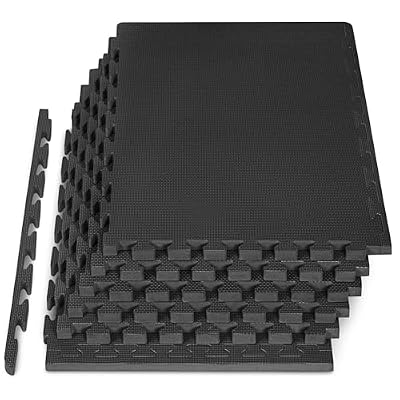
ProsourceFit Extra Thick Exercise Puzzle Mat, 1-inch
Our verdict:
Best if a rack joins the room
Best for a room that will add a rack or heavier gear, but where you still want foam.
View on Amazon- High-density EVA foam tiles, 24 x 24 in and 1 in thick
- 6 tiles and 12 end borders cover 24 sq ft
- Listing warns the surface can compress under heavy equipment
Keep in mind: the listing notes the surface can compress under heavy equipment.
Product details checked September 2026
Standout: ProSource rates this tier for ultra-heavy gear and high-traffic areas like large gyms (ProSource). Most home rooms don't need it. It earns its place in two cases: a rack that stays put for years, and a shared-wall flat where you want the thickest foam you can get.
#5. Rubber-Cal Eco-Sport Tiles: best rubber swap for foam tile
Rubber-Cal Eco-Sport Interlocking Rubber Tiles, 3/4 in
Our verdict:
Best rubber swap for foam tile
Best for anyone who likes tile but wants rubber that resists dents from fixed gear.
View on Amazon- 3/4-inch interlocking rubber tiles, 19.5 x 19.5 in each
- 10-pack covers about 28 sq ft
- Pitched for wet, high-traffic areas like gym floors and basements
Keep in mind: each tile weighs far more than foam, so laying a room takes longer.
Product details checked September 2026
Standout: 3/4-inch interlocking rubber tiles, 19.5 inches square. The maker pitches them for wet, high-traffic areas like gym floors and basements that flood. You keep tile's piece-by-piece repairs and gain rubber's density.
#6. Rubber-Cal Elephant Bark Roll: best if you'd rather roll than lock tiles
Rubber-Cal Elephant Bark 3/8-inch Rubber Flooring Roll
Our verdict:
Best if you'd rather roll than lock tiles
Best for a mostly square room you want covered in one sheet with few seams.
View on Amazon- 3/8 in x 4 ft x 8 ft sheet
- Made from recycled tire rubber
- For gym floors, equipment mats and basements, indoors or out
Keep in mind: at 3/8 inch it is a general training floor, not a heavy drop zone.
Product details checked September 2026
Standout: a 4 x 8 foot sheet of recycled tire rubber. Rubber-Cal describes it as moisture and mold resistant and safe to hose down (Rubber-Cal). For drop-rated rolls and stall mats, see best home gym flooring.
Factors to consider when choosing the best flooring for home gym use
The choice between tiers rests on four things: your heaviest gear, the material, the format and the room.
What the maker says about each tier
ProSource's product pages are direct. The 1/2-inch tile is for general exercise with standard gear, and the maker says to step up to the 3/4-inch tile once heavier equipment sits on it (ProSource). It describes the 3/4-inch tile as the pick for workouts and medium-traffic areas, able to take heavy exercise gear (ProSource). The 1-inch tile goes further, for ultra-heavy gear and high-traffic areas like large gyms (ProSource). That is more than most home setups need.
Match the tier to your room:
- Bodyweight, yoga, light dumbbells, occasional use: the 1/2-inch tile.
- An adjustable bench, moderate to heavy dumbbells, regular training: the 3/4-inch tile.
- A squat rack or heavy dropped plates: neither of these two. Use the 1-inch tile or rubber made for drops, covered in our flooring for home gym hub.
Why thickness is not the only number
Two products at the same thickness can suit different jobs. ProSource's tiles are EVA foam, a light closed-cell material that is easy to cut and carry but gives more under a steady load than rubber does. IRON COMPANY's GymLogix tile hits the same 1/2-inch mark in post-consumer crumb rubber, at 12 lb per 22 x 22 inch tile (IRON COMPANY). That is much heavier and denser than a foam tile of the same thickness.
This matters most for gear that sits in one spot for a long time. Think of a rack's feet, a bench's legs or a stack of stored plates. Foam can take a lasting dent under that kind of load, and rubber resists it better. If you move gear around the room, the gap matters less.
Rubber rolls have their own lines too. IRON COMPANY's warranty on its 3/8-inch rolled rubber says only its 1/2-inch and 3/4-inch versions suit heavy drop areas (IRON COMPANY). So a thin rubber roll and a thicker foam tile are not the same thing, even when the numbers look close.
Noise and vibration
ProSource markets its tiles as noise-reducing and shock-absorbing, which comes from the foam's cell structure (ProSource). No maker in this comparison publishes a decibel or vibration number. Treat "noise-reducing" as a trait of the material, not a measured amount of sound blocked. In a shared building, ask the maker directly if you need a real figure.
Tile or roll
Tile lets you replace one damaged piece and fit around posts or closet doors. A roll covers more floor with fewer seams and no edges to keep clean. Each roll run comes as one piece, though, so an odd-shaped room means more trimming. A small flat where the floor has to come up now and then suits tile better, since a roll is hard to lift and store in sections.
Material and cost
EVA foam is lighter and easy to cut and carry by hand. It usually costs less per square foot. Rubber is denser and holds up better under gear that stays put. You pay more per square foot for that.
Edge pieces and coverage
Foam tile sets usually come with beveled edge borders, so the floor doesn't leave a hard lip at the edge of the room. Check whether a listing includes them.
Measure the gear footprint plus room to move, not the whole room, unless you want wall-to-wall cover. Order a little extra for cutting waste. Both ProSource tiers use the same 24 x 24 inch tile, so the coverage math is the same. Only the tile weight and the cutting effort change.
Handling the thicker tier
A 3/4-inch foam tile is stiffer to flex when you cut around a post or door trim. Leave extra time for that step if your room is not a clean rectangle.
How we picked the best flooring for home gym rooms
We started from ProSource's own tier guidance, since most shoppers choose between its 1/2-inch and 3/4-inch tiles. We then added a like-for-like foam option and two rubber options that cover the same loads. IRON COMPANY specs come from its own product pages and help explain how rubber differs. We checked each pick against its current Amazon listing and did not test them by hand. Specs change, so read the current listing before you buy.
Matching flooring to the room, not just the gear
The same gear can call for a different tier in a different room. A basement on a concrete slab handles the thinner tiers fine, since the floor under them is already rigid. A spare bedroom over a wood-frame floor is where noise matters more, above all if someone uses the room below. Going up a tier, or adding a rubber layer under the foam, is a common fix.
When the 1-inch tier is worth it
Most home setups don't need the 1-inch tile. Two cases change that. The first is a squat rack that stays in one spot for years, where the extra depth helps resist long-term dents under the feet. The second is a shared-wall flat where impact noise worries you and you want the thickest foam option, even without a published decibel number. Outside those two cases, the 3/4-inch tier handles real gear without the extra cost and bulk.
Setup, warranty and install time
ProSource's tiles go down dry, with no glue, over concrete, wood or carpet, per the maker's own listings (ProSource). IRON COMPANY's rolled rubber also needs no glue for a normal home install, per its own install notes (IRON COMPANY). Confirm your subfloor against the exact product before you buy.
IRON COMPANY backs its rolled rubber with a 5-year limited warranty against defects. The listing also notes it is made in the USA and LEED Certified, with good traction when wet (IRON COMPANY). ProSource's tile pages we read don't state a warranty length, so check the current listing if that matters to you.
Tile is a same-day job for a typical room. The pieces press together by hand, and you trim the edge borders last. Cutting around posts, door swings or an odd wall adds time. A rubber roll goes down fast once it lies flat, but give it a day or two in the room first, since rubber can arrive stiff and curled from cold storage.
Protecting a wood subfloor
On wood, the goal is to spread the load so dropped or dragged gear doesn't dent or scratch the floor below. With tile, a scuff or a dropped plate affects one tile, and you can lift it to check the wood beneath. A roll protects just as well but doesn't allow that spot check.
A simple way to work through the choice
- List your heaviest real gear. Include anything you plan to add in the next year or two, like a rack or heavier dumbbells.
- Check that gear against the tier's stated use. Use the maker's own words, not the look of the mat.
- Pick tile or roll. Base it on room shape and whether you will ever need to swap a section.
- Measure the footprint. Add room to move and a little extra for cutting waste.
- Confirm the subfloor. Check your floor type against the exact listing, since products differ.
Common mistakes with the two tiers
- Buying 3/4-inch "just in case" for a bodyweight-only room. You pay more and add a higher step at the door for no real gain.
- Sticking with 1/2-inch after adding a rack or heavier dumbbells. ProSource's own guidance says heavier gear is the cue to move up.
- Treating all thin rubber as drop-rated. As the IRON COMPANY note shows, a 3/8-inch roll doesn't suit a drop zone the way a thicker version does.
- Measuring the room instead of the footprint. Order for your gear plus room to move, unless wall-to-wall is the plan.
Our verdict on the best flooring for home gym rooms
For most rooms, the ProsourceFit 3/4-inch puzzle mat is the best flooring for home gym use with a bench and dumbbells. BalanceFrom's 3/4-inch set is a close second. Keep the 1/2-inch tile for bodyweight and yoga corners. Choose Rubber-Cal's Eco-Sport tiles or Elephant Bark roll when you want rubber, and go to the 1-inch tile or a stall mat once a rack arrives.
Questions people also ask
Is 1/2-inch flooring enough for a home gym?
For bodyweight training, yoga and light dumbbell work, yes. That is the tier ProSource builds it for. Its own guidance is to move up to the 3/4-inch tile once heavier equipment sits on it (ProSource).
What changes between the 1/2-inch and 3/4-inch tiles?
Thickness and the stated use. Both come as 24 x 24 inch interlocking tiles, but ProSource makes the 3/4-inch version from denser high-density EVA foam and points to it once gear gets heavier (ProSource).
Should I just buy the thickest tile to be safe?
Not always. A thicker tile costs more per square foot and isn't needed for light use. Match the tile to your heaviest gear rather than defaulting to the top tier.
Can I combine two thicknesses in the same room?
Yes, and it is common. A thinner tier covers most of the floor, and a thicker or denser section goes under a rack or a drop zone. Check that the two edge shapes meet cleanly, since tiles from different lines don't always lock together.
Does this comparison apply to a garage floor?
The thickness logic is the same. A garage adds cold swings and bare concrete. See flooring for garage gym for that version of the choice.