
9 Best Foldable Gym Equipment Picks for Small Rooms in 2026
As an Amazon Associate, this website earns from qualifying purchases.
The short answer
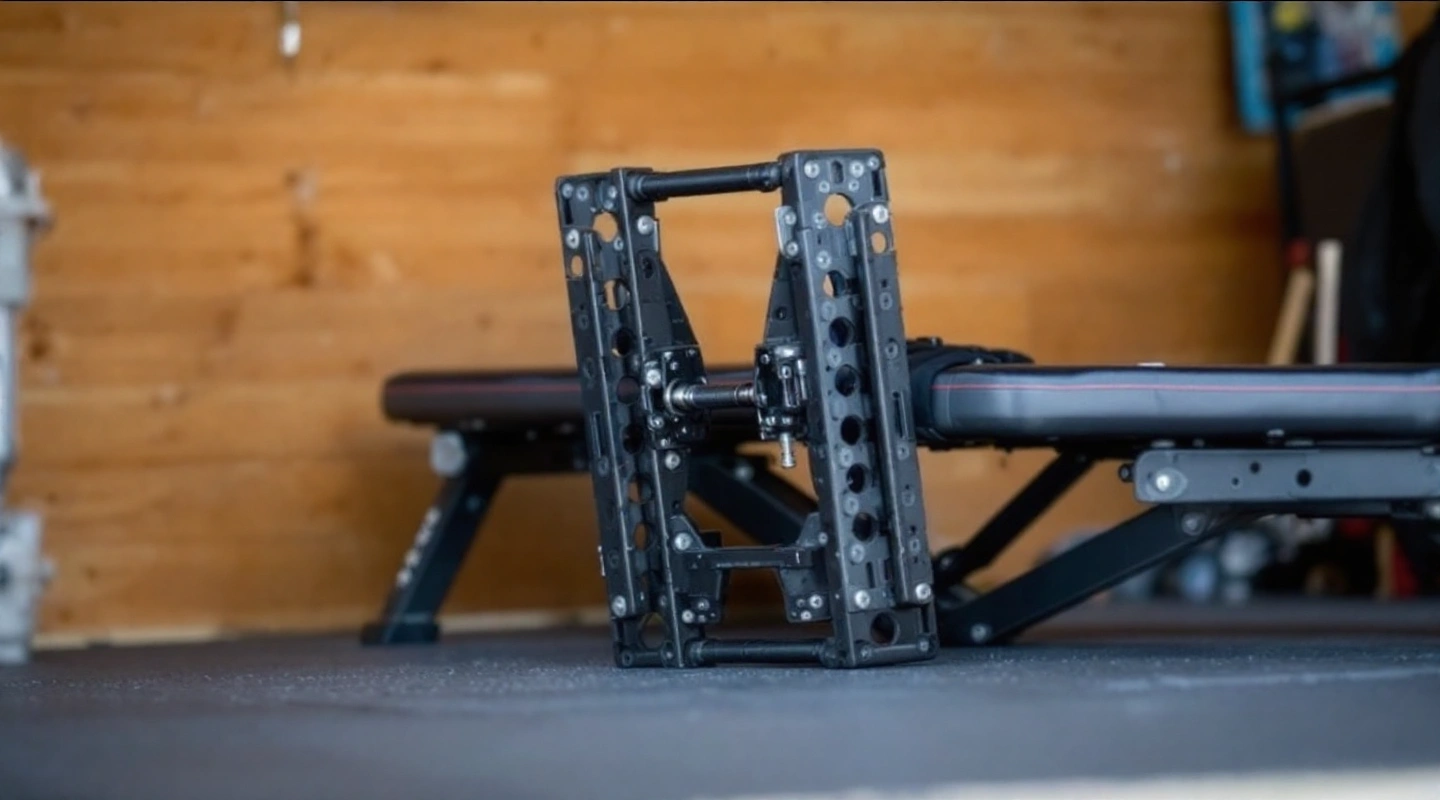
The best foldable gym equipment folds flat against a wall on real hardware. Start with the Titan T-3 folding rack, add the PRx flat folding bench or REP AB-3100, and use PowerBlock Elite EXP dumbbells in place of a dumbbell rack.
Last updated September 2026
Contents15
- #1. Titan T-3 Folding Power Rack: best folding rack
- #2. PRx Profile PRO 73 inch: best folding rack for low ceilings
- #3. Mikolo Folding Squat Rack: best folding rack with mounting parts
- #4. PRx Profile Flat Folding Bench: best wall-mounted bench
- #5. REP AB-3100: best freestanding folding bench
- #6. Titan Pop-Out Pull-Up Bar: best folding pull-up bar
- #7. Titan Foldable Angled Plyo Box: best folding plyo box
- #8. PowerBlock Elite EXP: best expandable dumbbells
- #9. Bowflex SelectTech 552: best dial dumbbells
- Factors to consider when choosing foldable gym equipment
- How we picked the best foldable gym equipment
- Setting up a folding rack for the first time
- Checking folding hardware once it's installed
- Building a small room from foldable pieces
- Our verdict on foldable gym equipment
Our top 9 picks
- 1Best folding rack
 Titan Fitness T-3 Series Wall-Mounted Folding Power Rack, 82 in x 21 in
- Swings flat against the wall when you are done
- 2x3 inch, 11-gauge steel uprights with Westside hole spacing
- J-hooks rated to 1,000 lb, pull-up bar included
- 2Best folding rack for low ceilings
 PRx Performance Profile PRO 73-inch Folding Squat Rack
- Wall-mounted rack that folds up on gas shocks
- Needs about 91 in of ceiling to fold; lower with a modified install
- 3x3 11-gauge steel, J-cups hold 600 lb
- 3Best folding rack with mounting parts
 Mikolo 2x2 Folding Wall-Mounted Squat Rack
- 2x2 inch, 13-gauge steel uprights, listed to 1,000 lb
- About 47 x 19.7 x 85.8 inches when open
- Stringer and mounting hardware included
- 4Best wall-mounted bench
 PRx Performance Profile Flat Folding Bench
- Wall-mounted flat bench that folds up close to the wall
- Made to pair with PRx Profile ONE, PRO and Murphy racks
- Arrives assembled; mounts to wall studs with the included hardware
- 5Best freestanding folding bench
 REP AB-3100 Adjustable Weight Bench
- Solid steel frame built for home strength training
- Listing describes it as a foldable FID bench that stores vertically
- High-density foam with sweat-resistant vinyl upholstery
- 6Best folding pull-up bar
 Titan Fitness Pop-Out Wall-Mount Folding Pull-Up Bar
- Folds flat to the wall, about 4.5 in deep when closed
- Rated to 250 lb
- Knurled and smooth grip zones; mounting hardware not included
- 7Best folding plyo box
 Titan Fitness Foldable Angled Plyo Box
- Opens to a 30 degree slant and locks with a pin
- 23.5 inch footplate on a 29 x 24 inch footprint
- 48 lb steel frame that folds flat and rolls on wheels
- 8Best expandable dumbbells
 PowerBlock Elite EXP Stage 1 Adjustable Dumbbells (Pair)
- 5 to 50 lb per hand, with a 2.5 lb adder for half steps
- Block measures 12 x 6 x 6 inches
- Stage 2 and 3 kits, sold separately, reach 70 and 90 lb
- 9Best dial dumbbells
 Bowflex SelectTech 552 Adjustable Dumbbells (Pair)
- Dials set each dumbbell from 5 to 52.5 lb
- Stands in for 15 separate weights
- Metal plates with a locking system and a non-slip handle
Foldable gym equipment is strength gear built to shrink its own footprint when you're not using it. That covers a rack that folds flat against a wall and a bench that folds onto a bracket or its own legs. It also covers a dumbbell set that replaces a whole rack of fixed weights with one pair. The common thread is real folding hardware, not just a smaller than average size.
We ranked nine picks across racks, benches, pull-up bars, plyo boxes and dumbbells. Each one has a verified Amazon listing. Cable machines like Torque's F9 and Tonal 2 appear in the buying guide below for comparison.
#1. Titan T-3 Folding Power Rack: best folding rack
Titan Fitness T-3 Series Wall-Mounted Folding Power Rack, 82 in x 21 in
Our verdict:
Best folding rack
Best for a garage or spare room where a fixed rack would block the floor.
View on Amazon- Swings flat against the wall when you are done
- 2x3 inch, 11-gauge steel uprights with Westside hole spacing
- J-hooks rated to 1,000 lb, pull-up bar included
- Wall-mounting hardware is not in the box
Keep in mind: you buy the wall hardware separately.
Product details checked September 2026
Standout: Titan sells it at 82 or 91 inches tall and 21.5 or 41.5 inches deep. The 2x3 inch uprights take Titan's T-3 add-ons.
#2. PRx Profile PRO 73 inch: best folding rack for low ceilings
PRx Performance Profile PRO 73-inch Folding Squat Rack
Our verdict:
Best folding rack for low ceilings
Best for basements and garages under 8 feet.
View on Amazon- Wall-mounted rack that folds up on gas shocks
- Needs about 91 in of ceiling to fold; lower with a modified install
- 3x3 11-gauge steel, J-cups hold 600 lb
Keep in mind: the J-cups hold 600 lb.
Product details checked September 2026
Standout: PRx's patented fold uses gas shocks at each pivot, so one person can lift the frame to the wall.
Pick this if: you train in a garage that must still park a car. The rack pulls out from the wall to train and folds back to park. Measure your studs and the lowest point of the door track first, since both decide which height and depth will work.
#3. Mikolo Folding Squat Rack: best folding rack with mounting parts
Mikolo 2x2 Folding Wall-Mounted Squat Rack
Our verdict:
Best folding rack with mounting parts
Best for buyers who want a stringer and hardware in the box.
View on Amazon- 2x2 inch, 13-gauge steel uprights, listed to 1,000 lb
- About 47 x 19.7 x 85.8 inches when open
- Stringer and mounting hardware included
- Pull-up bar, J-cups and landmine attachment
Keep in mind: its 2x2 inch uprights fit fewer add-ons than larger racks.
Product details checked September 2026
Standout: Mikolo puts the stringer and metal studs in the box, which many brands leave out. The listing also includes a pull-up bar, J-cups and a landmine, so the rack is close to ready once it is on the wall. Its open depth of about 19.7 inches keeps it shallow even in use.
#4. PRx Profile Flat Folding Bench: best wall-mounted bench
PRx Performance Profile Flat Folding Bench
Our verdict:
Best wall-mounted bench
Best for owners of a PRx rack who want the bench to fold away with it.
View on Amazon- Wall-mounted flat bench that folds up close to the wall
- Made to pair with PRx Profile ONE, PRO and Murphy racks
- Arrives assembled; mounts to wall studs with the included hardware
Keep in mind: it is flat only, with no incline.
Product details checked September 2026
Standout: The bench arrives assembled and folds up between the uprights of a PRx Profile ONE, PRO or Murphy rack. Rack and bench then share one strip of wall, and the floor stays clear when both are up. PRx's own specs give a 61 inch stowed height.
#5. REP AB-3100: best freestanding folding bench
REP AB-3100 Adjustable Weight Bench
Our verdict:
Best freestanding folding bench
Best for renters and anyone who can't drill for a wall bench.
View on Amazon- Solid steel frame built for home strength training
- Listing describes it as a foldable FID bench that stores vertically
- High-density foam with sweat-resistant vinyl upholstery
Keep in mind: it folds upright but still needs a corner.
Product details checked September 2026
Standout: A freestanding bench needs no studs at all, so it works in any room. Fold it upright and stand it in a corner or a closet between sessions. It pairs with any rack on this list, including one you already own.
#6. Titan Pop-Out Pull-Up Bar: best folding pull-up bar
Titan Fitness Pop-Out Wall-Mount Folding Pull-Up Bar
Our verdict:
Best folding pull-up bar
Best for a room with no rack, or a second bar away from the rack.
View on Amazon- Folds flat to the wall, about 4.5 in deep when closed
- Rated to 250 lb
- Knurled and smooth grip zones; mounting hardware not included
Keep in mind: it is rated to 250 lb, well under a fixed bar.
Product details checked September 2026
Standout: Closed, it sits 4.5 inches from the wall and locks open with one pin. It is the smallest fix on this page, and it makes sense where a fixed bar would stick out into a walkway. Titan leaves out the hardware, so buy lag bolts sized for your studs.
#7. Titan Foldable Angled Plyo Box: best folding plyo box
Titan Fitness Foldable Angled Plyo Box
Our verdict:
Best folding plyo box
Best for step-ups, calf stretches and lateral jumps in a small room.
View on Amazon- Opens to a 30 degree slant and locks with a pin
- 23.5 inch footplate on a 29 x 24 inch footprint
- 48 lb steel frame that folds flat and rolls on wheels
Keep in mind: the angled top is not a straight swap for a flat box jump.
Product details checked September 2026
Standout: It folds flat and rolls on built-in wheels, so it can live in a closet. The steel frame weighs 48 lb, and the listing gives a 29 by 24 inch footprint when open. Use it for slant work and step-ups rather than tall vertical jumps.
#8. PowerBlock Elite EXP: best expandable dumbbells
PowerBlock Elite EXP Stage 1 Adjustable Dumbbells (Pair)
Our verdict:
Best expandable dumbbells
Best for replacing a shelf of fixed pairs, with room to grow.
View on Amazon- 5 to 50 lb per hand, with a 2.5 lb adder for half steps
- Block measures 12 x 6 x 6 inches
- Stage 2 and 3 kits, sold separately, reach 70 and 90 lb
- 5 year residential warranty
Keep in mind: Stage 2 and 3 kits cost extra.
Product details checked September 2026
Standout: One 12 by 6 by 6 inch block per hand replaces a whole shelf of fixed pairs. When you get stronger, the Stage 2 and 3 kits raise the top weight to 70 or 90 lb per hand. You keep the base block, so you never buy the whole set twice.
#9. Bowflex SelectTech 552: best dial dumbbells
Bowflex SelectTech 552 Adjustable Dumbbells (Pair)
Our verdict:
Best dial dumbbells
Best for quick weight changes with a twist of a dial.
View on Amazon- Dials set each dumbbell from 5 to 52.5 lb
- Stands in for 15 separate weights
- Metal plates with a locking system and a non-slip handle
- Storage trays included with the pair
Keep in mind: it tops out at 52.5 lb per hand with no expansion kit.
Product details checked September 2026
Standout: You twist the dials to set the weight, so changes are quick between sets. The pair replaces 15 separate weights and comes with storage trays. It suits people who stay under about 50 lb per hand.
Factors to consider when choosing foldable gym equipment
Foldable squat racks
A folding squat rack mounts to wall studs and swings flat against the wall on hinged brackets. PRx Performance's Profile PRO is 11-gauge, 3x3 inch steel. It comes in 81, 89 and 95 inch upright heights, with brackets for 16 or 24 inch on-center studs (PRx Performance). The 73 inch model's J-cups hold 600 lb.
Ceiling height scales with upright height. PRx recommends an 8'3" (99 inch) ceiling for the 81 inch rack. It asks for 8'11" (107 inches) for the 89 inch rack and 9'5" (113 inches) for the 95 inch rack. PRx also lists modified installs for lower ceilings on request. The 73 inch model needs 91 inches, or 80 with a modified install, per its listing.
PRx's Profile Folding Full Cage steps up from two uprights to four, in the same 11-gauge steel. Its uprights sit 48 inches apart, with a 54.5 by 54.75 inch footprint when open. Folded in, it takes just 70 by 12 inches of wall, on the same stud spacing, with a 1,000 lb overall rating (PRx Performance). The full cage mainly buys a rear pair of uprights for safety arms and a closed pull zone. That is worth it if you train heavy without a spotter.
Titan Fitness sells two folding lines. The X-3 uses 3x3 inch, 11-gauge uprights in 80 and 90 inch heights (Titan Fitness). Its listings give J-hooks rated to 1,000 lb and fold depths of about 5 to 8 inches, depending on the model. The T-3 steps down to 2x3 inch, 11-gauge uprights. It comes in 82 or 91 inch heights with 21.5 or 41.5 inch depths, and its J-hooks are also rated to 1,000 lb, per the listing.
Mikolo's folding rack uses lighter 2x2 inch, 13-gauge steel, per its listing. It stands about 85.8 inches tall and about 19.7 inches deep when open. The listing gives a 1,000 lb rating and includes a stringer and metal studs for mounting. Check your wall type against Mikolo's install guide before you pick it.
All of these need a solid wall and the maker's own bracket hardware. None are built to anchor into drywall alone. No brand's mounting hardware swaps with another's.
Rogue Fitness sells another folding rack worth comparing: the Monster Lite RML-3W Fold Back Wall Mount Rack. It uses 3x3 inch, 11-gauge uprights, a 90.375 inch height and 5/8 inch SAE grade 5 bolts. It folds back to less than 5 inches from the wall (Rogue Fitness). It ships in 21.5 or 41.5 inch depths and mounts across four wood studs on a stringer.
Rogue doesn't publish an overall weight rating the way PRx and Titan do. If a stated capacity matters to you, that is a real point in favor of the other brands. Rogue sells direct, not on Amazon.
So there are several comparable folding rack lines. They solve the same problem in different ways.
PRx gives the lowest heights and the gas-shock fold. Titan gives the most height and depth options. Mikolo ships the stringer in the box. Rogue gives a shallow fold with heavy bolts but no published rating.
Foldable pull-up bars
A pull-up bar doesn't take much space, but a folding one still helps in a room where a fixed bar is one more thing to walk into. Titan Fitness's Pop-Out Pull-Up Bar mounts to wood studs. It swings out to a 49.25 inch open length with a 37 inch working bar and a 32 mm grip that is part smooth and part knurled. It folds back to 4.5 inches deep on a single locking pin (Titan Fitness).
It is rated to 250 lb. That is lighter duty than the fixed wall and ceiling bars Titan also sells at up to 500 lb. The trade for the fold is a lower rating, not a free upgrade.
If you already own a folding wall rack, you may not need a separate bar. PRx's Profile ONE and several Titan racks sell a pull-up bar that mounts across the rack's own uprights. It folds away with the rack. A standalone folding bar makes more sense in a room with no rack, or as a second bar.
Foldable plyo boxes
Most adjustable plyo boxes change height with a pin, not by folding flat. REP Fitness's Adjustable Plyo Box sets to 16, 20 or 24 inches, and Titan sells a 12 to 24 inch adjustable steel box. Both store at close to full size.
Titan's Foldable Angled Plyometrics Box is built to fold. It opens to a 30 degree slant 15 inches tall, 24 inches wide and 29 inches deep. It has a 23.5 inch square non-slip footplate and folds flat, with wheels and a 350 lb user limit (Titan Fitness). At 48 lb per unit and sold as a set of two, it suits step-ups and lateral jumps, plus calf and shin stretches. Check the slant use against what you need before you buy it in place of a flat box.
Foldable functional trainers and cable machines
This is where folding wins back the most floor compared with a standard cable machine. A functional trainer's twin towers and arms normally need their own footprint. Torque Fitness's Wall-Mounted F9 mounts to wood studs and folds its doors flat to a 14 inch closed depth. It opens to 39.5 inches deep, with 150, 200 or 225 lb stacks on each side and a built-in pull-up bar (Torque Fitness).
Its cables run at a 1:2 ratio across all stack sizes. A 150 lb stack setting gives 75 lb of real resistance per side. So read the stack number with that ratio in mind, not as a 1:1 figure.
Mikolo's CHEETAH combines a folding power rack with cable crossover, a lat pulldown, a pull-up bar and a functional trainer in one wall unit. Mikolo lists lighter 2x2 inch, 14-gauge steel, 300 lb static and 250 lb dynamic per side, and about 3 square feet folded (Mikolo). Mikolo prefers a concrete or brick wall. It calls for stringer boards behind the wall surface on a wood-stud wall.
Tonal 2 takes the folding cable idea furthest. Its motorized arms retract to 5.5 inches from the wall. The unit is 50.9 inches tall by 21.5 inches wide and gives up to 250 lb of digital resistance, 125 lb per arm (Tonal product page; Tonal support knowledge base, max supported weight). It is the shallowest fold on this page. It is also a very different product: a powered, screen-driven system, not a plate or pin-loaded machine.
None of these three is one of our picks, since we did not verify an Amazon listing for them. They are here so you can compare fold depth and rated load.
Foldable flat benches
A flat folding bench gives you a surface for bench press and dumbbell work, then folds close to the wall. The Valor Fitness DA-4 is a plain example. It measures 47 by 12 by 17.5 inches set up, and just 8.5 inches deep folded on its bracket. It lists a 1,200 lb static and 660 lb dynamic rating (Valor Fitness).
PRx Performance's Profile Flat Folding Bench works the same way at a larger size. It is 17 by 12 by 45 inches open and folds up to a 61 inch stowed height flat on the wall (PRx Performance). It fits between the uprights of PRx's own Profile CORE, Profile PRO and Murphy racks. So hardware and stud spacing line up if you own one of those.
Foldable adjustable benches
An adjustable folding bench adds incline and decline to the fold. PRx's Profile Incline Folding Weight Bench moves through 12 positions from flat up to 85 degrees. It opens to 18 by 18 by 65.25 inches and folds back to 8 inches from the wall, on the same 16 inch stud spacing as the flat bench (PRx Performance).
Freestanding benches fold their own frame instead. The REP AB-3100 folds upright for storage and sets to flat, incline or decline, per its listing. For more options, see the foldable adjustable weight bench picks.
Adjustable dumbbells: a whole rack in one pair
Adjustable dumbbells solve a different space problem. One pair covers a full weight range instead of a long shelf of fixed pairs. The Bowflex SelectTech 552 dials from 5 to 52.5 lb per hand in 2.5 lb steps, with each dumbbell about 16.9 by 8.3 by 9 inches (Bowflex). That is close to the size of one fixed dumbbell, not fifteen pairs.
There is no expansion kit past 52.5 lb. Outgrowing it means buying a heavier set.
PowerBlock's Elite EXP starts smaller: 5 to 50 lb per hand in a 12 by 6 by 6 inch block, in 2.5 and 5 lb steps. Expansion kits extend the range without replacing the base. Stage 2 grows the block to 14 by 6.25 by 6 inches and goes to 70 lb per hand. Stage 3 grows it to 16 by 6 by 6 inches for a 90 lb ceiling (Rogue Fitness). Each stage is sold on its own, so you can match storage size and spend to your strength today.
Folded footprint by type, side by side
Here is how the folded or stored size compares across the gear on this page. Wall racks from Titan and Rogue fold to roughly 5 inches from the wall, and PRx's Murphy listing gives 4 inches. PRx's full cage uses 70 by 12 inches of wall. Wall benches sit about 8 to 8.5 inches out: 8 inches for PRx's incline bench and 8.5 inches for Valor's DA-4.
Titan's folding pull-up bar closes to 4.5 inches. Tonal's arms retract to 5.5 inches, and Torque's F9 closes its doors at 14 inches deep. Mikolo lists its CHEETAH at about 3 square feet folded.
Freestanding pieces have no wall depth at all, but they still take floor or shelf space. A Bowflex 552 dumbbell is about 16.9 by 8.3 by 9 inches. A PowerBlock Elite EXP block is 12 by 6 by 6 inches at Stage 1. The REP AB-3100 and Titan's plyo box fold and then stand or roll into a corner.
Ratings vary just as widely. Folding racks run from 600 lb on the PRx 73 inch J-cups to 1,000 lb on Titan's J-hooks. The Valor DA-4 lists 1,200 lb static and 660 lb dynamic. Titan's folding bar is rated to 250 lb, and its plyo box to a 350 lb user. Read each number for what it covers: J-cups, the whole frame or the user.
How the wall-mounted fold works
PRx's wall racks and benches fold on hinged brackets at each mount point. Gas shocks cut the effort needed to lift the frame back to the wall. PRx's Incline Folding Weight Bench uses 120 lb gas shocks to offset an 85 lb bench frame, and the rack line uses the same idea (PRx Performance). That is different from a rack you unbolt and carry away. The hardware stays mounted and the frame swings, so setup takes seconds without tools.
Stud spacing matters because the brackets bolt into studs. PRx asks for 16 or 24 inch on-center studs across its Profile racks and benches. If your studs land in between or are uneven, the fix is a horizontal ledger board bolted across them (PRx Performance). Bolting into drywall alone is not a safe substitute. It is the most common way a wall setup fails.
The fold itself differs by type. A folding pull-up bar like Titan's uses a single locking pin. You pull it, swing the bar out and push the pin back in (Titan Fitness). A folding rack or bench uses a hinged bracket at each mount instead, because the load runs through the whole frame.
A folding functional trainer adds a third design. Torque's F9 closes two full-height doors over the cable towers (Torque Fitness). Mikolo's CHEETAH folds like a rack, and its pull-up bar and handles come off entirely (Mikolo). Tonal 2 is the outlier. Its arms retract by motor, so there is no pin or shock to check (Tonal).
Bolt count is a rough guide to how load-bearing a mount is meant to be. Rogue's RML-3W calls for a stringer across four wood studs and 5/8 inch SAE grade 5 bolts (Rogue Fitness). That hardware suits a rack that takes a loaded bar again and again. Torque's F9 is commonly installed with about a dozen bolts into studs. At least one published review added extra bolts for more stability during pull-ups (Torque Fitness).
A folding pull-up bar usually mounts on far fewer points, in line with its lower rating. None of this is a reason to skip the maker's hardware or bolt count. It is a way to sanity-check that the hardware matches the weight class a listing claims.
Matching a bench to a rack brand
Not every folding bench pairs with every folding rack. PRx builds its Profile Flat Folding Bench and Profile Incline Folding Weight Bench to mount between the uprights of its own Profile CORE, Profile PRO and Murphy racks. Both use the same 16 inch stud spacing as the rack (PRx Performance).
Titan takes another route. It sells a Wall Mounted Bench Hanger, a bracket that stores a standard bench on 16 inch stud centers (Titan Fitness). It doesn't fold the bench itself. If you want one brand for rack and bench, check whether it makes a matching folding bench or only a hanger.
If you can't drill into a wall
Every wall rack and bench above needs real stud access. That rules out the wall category for many renters. Freestanding options don't fold as flat, but they skip drilling.
The PowerBlock Elite EXP and Bowflex SelectTech 552 sit on the floor or a shelf with no hardware. The REP AB-3100 folds its own frame. Titan's folding plyo box is freestanding and rolls on its own wheels (Titan Fitness).
The cable machine type has no clear freestanding folding option among the products on this page. Torque's F9, Mikolo's CHEETAH and Tonal 2 are all wall-mounted. A renter who can't drill is better off skipping folding cable gear than hunting for a freestanding version that doesn't clearly exist yet.
If no wall rack works in your space, build around a freestanding bench, adjustable dumbbells and a folding plyo box. That keeps a room's footprint small with no drilling at all.
When a fold isn't worth paying for
Folding hardware adds cost and moving parts. A hinge, gas shock or locking pin is one more thing that can wear out. That trade is clearly worth it when the other choice is a rack or cable machine blocking a walkway or parking spot. It is a closer call for a small, narrow item.
Titan's Pop-Out Pull-Up Bar folds to 4.5 inches. A fixed Titan bar sticks out only a little more and carries double the rating, 500 lb versus 250 lb (Titan Fitness). If your room has a dead corner where a fixed bar bothers no one, the fixed bar's higher rating and simpler hardware may be the better buy.
The same logic applies to plyo boxes. If a fixed or stackable box can live on a shelf undisturbed, Titan's or REP's non-folding boxes have one less moving part. Folding is worth paying for when it solves a real space conflict, not for its own sake.
What to check before you buy any of it
- Stud spacing at your mounting spot. 16 or 24 inches on center is standard for wall racks and benches; uneven studs need a ledger board. Some brands, like Mikolo, prefer concrete or brick, so read the install guide.
- Ceiling height to fold a rack up. Taller uprights need more room overhead.
- Folded depth from the wall, in inches from the maker, not the word compact. It runs from a 70 by 12 inch wall footprint on PRx's full cage down to about 5 inches on most folding racks. Titan's folding bar closes to 4.5 inches and Tonal's arms to 5.5 inches.
- Weight rating, and whether it is static or dynamic. Dynamic ratings account for movement and are usually lower. A folding bar or plyo box is often rated below a fixed version, since the fold is a weaker point than a solid weld.
- Brand matching. PRx's benches fit PRx racks. Titan sells a bench hanger, not a folding bench. A rack-mounted pull-up bar usually only bolts to that brand's uprights.
- What the fold replaces. A folding rack or bench swaps floor for wall. A folding cable machine swaps a multi-tower footprint for one wall panel. Adjustable dumbbells replace a shelf of fixed pairs. Match the trade to what is crowding your room.
Which foldable type fits your space
Start with what takes the most floor now, not with whichever type has the most marketing. Measure the room with every piece folded, then again with the one you use most set up. The gap between those two numbers is the space the fold actually wins you.
- A fixed rack blocks a walkway or parking spot. A folding wall rack is the direct fix, but only with stud or masonry access. Without it, a freestanding rack is the honest answer.
- A bench is in the way, not a rack. Go straight to a folding bench. A wall-mounted flat bench folds flattest. A freestanding bench like the REP AB-3100 needs no wall.
- You want a full dumbbell rack's range from one shelf spot. Adjustable dumbbells solve this without touching a wall.
- A cable machine's twin towers are the biggest thing in the room. This is where folding wins back the most space. Torque's F9 or Tonal's arms fold to well under a foot deep.
- A pull-up bar or plyo box sticks out and you walk into it. These are the smallest fixes here, but a folding version is the direct swap.
- You can't drill into any wall. Rule out every wall type and build around freestanding pieces: a folding bench, adjustable dumbbells and a folding plyo box.
- The floor itself is the problem. Bare concrete, a noisy slab or a surface you don't want to dent is a flooring choice. See flooring for home gym for how tiles and rolls compare by thickness and load.
How we picked the best foldable gym equipment
We looked for gear that truly changes its footprint when you're done, not gear that is just small. For each type we read the Amazon listing and the maker's spec pages. We compared fold depth and wall needs, then ceiling height and rated load. Only products with a verified Amazon listing became picks.
Rogue, Valor, Torque, Mikolo's CHEETAH and Tonal appear in the text for comparison. We did not test this gear by hand, so check the current listing before you buy.
Setting up a folding rack for the first time
A little planning makes the first install go well. Start by finding every stud along the wall with a stud finder, and mark them in pencil. Then check the rack's install guide for the stud spacing and bolt size it wants. If the studs don't line up, plan a ledger board or stringer first.
Next, measure the ceiling at the exact spot, not in the middle of the room. A door track, light or duct can sit lower than the ceiling. Compare that number with the height the maker says the rack needs to fold up. Leave room for a pull-up bar if yours has one.
Then mark the open footprint on the floor with tape. Stand in it with a bar or a broom handle and walk through a squat and a bench setup. Check that a car door, a workbench or a walkway still clears it. Titan recommends two people for its rack installs, so plan a helper. Keep the install guide with the rack for later checks.
Checking folding hardware once it's installed
Folding gear has a check that fixed gear doesn't. On a fixed rack or bench, the main risk is the first install. On anything that folds, there is a second, repeating risk: a pin or bracket not fully set after the last fold-out.
Titan's Pop-Out Pull-Up Bar relies on a single locking pin to hold its working position (Titan Fitness). A pin that isn't pushed all the way through is the difference between a bar that holds and one that doesn't. PRx sizes its gas shocks to a set frame weight: 120 lb shocks against an 85 lb bench frame on its Incline Folding Weight Bench (PRx Performance). A shock that has clearly lost lift since new is a sign of wear worth fixing.
None of the makers on this page publish an inspection schedule. So the habit is the same for every type. Glance at the pin or bracket each time before you load weight. Don't assume a fold that seated right last time will always seat the same way.
Building a small room from foldable pieces
These types don't work alone if your goal is a usable room. A folding rack solves the biggest footprint, and a folding bench handles the next. Adjustable dumbbells replace a long shelf of fixed weights. A folding cable machine swaps a multi-tower footprint for one wall panel. Smaller pieces like a folding bar or plyo box matter less in square feet, but they add up in a tight room.
Start with whatever piece blocks the most floor now. For most small rooms, that is the squat rack or the cable machine. Build out from there, checking stud access and fold depth at each step. Once the gear is settled, confirm the flooring under it is rated for your heaviest load. See flooring for home gym for that comparison by thickness and material.
A small-room build usually settles into one of two shapes. The wall-heavy version puts a folding rack, a folding bench and maybe a folding cable machine on stud-mounted walls. The floor stays almost clear except for a shelf of adjustable dumbbells and a folded plyo box. It needs the most stud access up front but gives back the most floor each day.
The freestanding version skips wall mounting. A freestanding folding bench, adjustable dumbbells and a folding plyo box cover strength and conditioning without a single bolt. The cost is that nothing folds quite as flat, and you need a corner or closet for the folded pieces.
Neither shape is better in general. The wall version assumes a wall you can drill and, most often, a home you own. The freestanding version assumes you'll trade some fold depth for zero install. Pick the shape that matches your wall access first, then use the picks above to choose models.
For the full rack comparison, see the folding squat rack hub. For flat-only benches, see folding weight benches. For more dumbbell picks, see the best adjustable dumbbells guide.
Our verdict on foldable gym equipment
The best foldable gym equipment folds flat on real hardware and solves a real space conflict. Start with the Titan T-3 folding rack, or the PRx Profile PRO 73 inch for a low ceiling. Add the PRx flat folding bench if you own a PRx rack, or the REP AB-3100 if you can't drill. PowerBlock Elite EXP dumbbells replace a dumbbell rack, and the Titan pull-up bar and plyo box fill the smaller gaps.
Questions people also ask
What counts as foldable gym equipment, versus just compact?
Foldable gear changes its own footprint. Think of a rack that swings flat against a wall, a bench that folds its legs or folds onto a bracket, or a cable machine whose towers fold to a few inches deep. Compact gear is just smaller than average. It doesn't shrink further when you're done. Check the folded size, not just the in-use size.
Do I need a wall-mounted rack before buying a wall-mounted bench?
Not always, but it helps. PRx Performance's Profile Flat Folding Bench and Profile Incline Folding Weight Bench are built to mount between the uprights of PRx's own Profile and Murphy racks, on the same stud spacing (PRx Performance). You can mount either bench on its own wall section without a rack. You still need the same 16 inch on-center stud access.
Is a folding rack or a folding bench the better first buy for a small room?
It depends on what is eating your space now. If a fixed rack blocks a walkway or parking spot, a folding wall rack like PRx's Profile PRO or Titan's T-3 fixes that. If the room has no rack and a bench is in the way, start with a folding bench. Either way, confirm your wall has usable studs first. It is the one need neither type can work around.
Do folding cable machines save more space than a folding rack?
Compared with their non-folding versions, usually yes. A freestanding functional trainer's twin towers take several feet of floor all the time. A folding version like Torque's Wall-Mounted F9 or Tonal's motorized arms folds to well under a foot deep (Torque Fitness; Tonal). A folding rack saves real space too. A fixed rack is narrower to begin with, so the share of floor you win back is usually larger with a folding cable machine.
Does foldable gym equipment hold as much weight as fixed gear?
Folding racks can come close. Titan's T-3 folding rack lists J-hooks rated to 1,000 lb, the same figure as its fixed T-3 racks. Smaller folding pieces often carry less. Titan's folding pull-up bar is rated to 250 lb, while its fixed bars go up to 500 lb (Titan Fitness). Read the rating for the exact part you will load, and follow the maker's wall hardware and bolt count.